Description
Product Overview
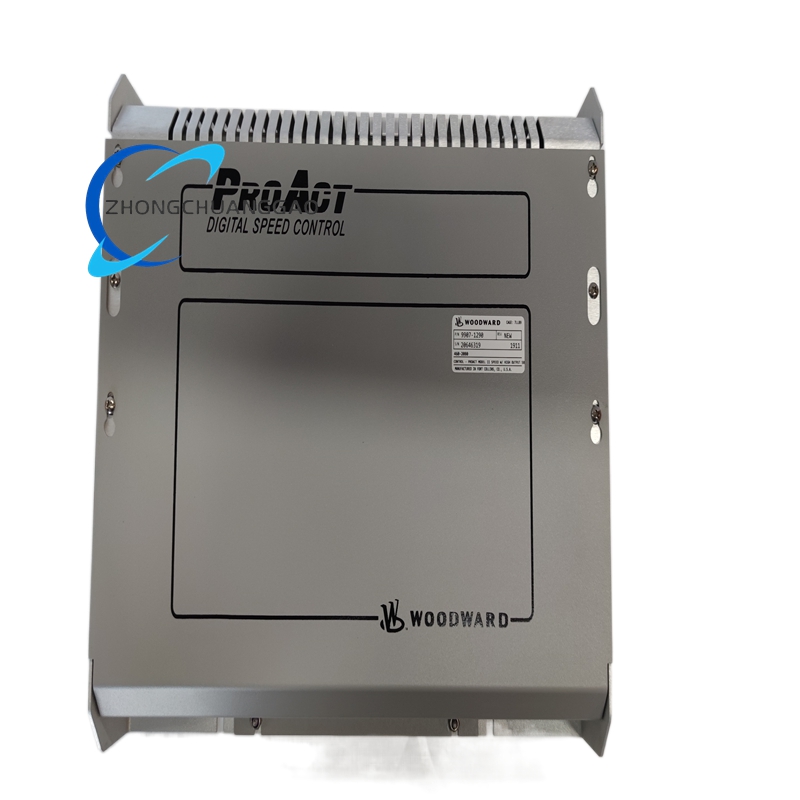
The Woodward 9907-1290 is a direct-acting electro-hydraulic servo actuator designed to provide high-speed, high-force valve positioning for steam turbine main steam valves, control valves, and gas turbine fuel valves in power generation, oil and gas, and industrial process applications. It delivers a maximum thrust of 10,000 lbf (44,500 N) and a maximum stroke of 4 inches (100 mm) with a full stroke time of less than 0.5 seconds. The unit features a torque motor with LVDT position feedback, an internal servo valve, and dual redundant solenoid valves for SIL 2 / SIL 3 safety applications. The 9907-1290 is the standard actuator paired with Woodward 505, 505E, 505F, 5437, 8440, and 9905 series governors and position controllers for complete turbine speed and valve position control systems. It is drop-in compatible with legacy Woodward 9907-010 through 9907-150 actuators, requiring zero redesign of mounting, piping, or wiring.
Technical Specifications
Functional Features
- Direct-acting electro-hydraulic design — hydraulic pressure acts directly on the actuator piston, no mechanical linkage, zero backlash
- 10,000 lbf maximum thrust at 3,000 psig — sufficient force for main steam valves on turbines up to 500 MW
- 4 inch maximum stroke — accommodates large-bore main steam valves and control valves
- Full stroke time < 0.5 seconds — enables fast turbine trip and rapid load acceptance
- Built-in LVDT position feedback — provides continuous valve position signal to governor or position controller, eliminates need for external position transmitter
- Internal servo valve — high-response spool valve modulates hydraulic flow to actuator piston, no external servo valve required
- Dual redundant solenoid valves — two independent solenoids de-energize on trip condition, provides SIL 2 / SIL 3 certified safety shutoff
- Torque motor with 50 Ohm impedance — accepts ±50 mA command signal from Woodward 9905, 5437, 8440 governors or equivalent analog controllers
- Integral pressure relief valve — set at 3,500 psig (241 bar), protects actuator from overpressure damage
- Manual override handwheel — allows manual valve positioning during actuator maintenance without removing the actuator from service
- Position indicator scale — mechanical position scale on actuator body for visual valve position verification
- Low-friction piston seals — PTFE-filled seal design minimizes stiction and ensures smooth operation at low speeds
- Internal oil filter — 10 micron absolute filtration protects servo valve spool from contamination
- Bleed valve — integral bleed valve allows air purging during commissioning
- Connection ports — 3/8 inch NPT supply port, 1/2 inch NPT return port, 1/4 inch NPT drain port, all located on actuator head for easy piping
- Corrosion-resistant finish — all external steel surfaces receive phosphate conversion coating with black oxide finish
- Nameplate — permanent stainless steel nameplate with model number, serial number, thrust rating, pressure rating, and certification marks
Performance Parameters
Material Composition
Structural Features
- Forged steel cylinder body — single-piece forged construction eliminates weld failures under 10,000 lbf thrust loads
- Trunnion mounting design — actuator pivots on trunnion pins, eliminates side loading on valve stem
- Flange mounting option — NEMA flange pattern for direct bolt-on to valve yoke, eliminates need for custom adapter
- Side-mount option — actuator mounts parallel to valve axis for space-constrained installations
- Integral servo valve — compact spool-type servo valve mounted inside actuator head, eliminates external servo valve piping
- Dual redundant solenoid valves — two independent solenoids mounted in parallel, each capable of full flow shutoff alone
- Built-in LVDT — linear variable differential transformer mounted on actuator piston rod, provides continuous position feedback
- Torque motor assembly — mounted on top of actuator head, receives ±50 mA command signal from governor
- Manual override handwheel — 12-position handwheel on actuator head allows manual valve stroking during maintenance
- Position indicator scale — 0 to 100% mechanical scale engraved on actuator body for visual position verification
- Bleed valve — 1/4 inch NPT bleed valve on actuator head for air purging during commissioning
- Pressure relief valve — internal relief valve set at 3,500 psig protects actuator from overpressure
- Internal oil filter — 10 micron absolute filter in hydraulic supply line protects servo valve spool
- Drain port — 1/4 inch NPT drain port on bottom of actuator head for condensation removal
- Supply port — 3/8 inch NPT female ORB fitting on actuator head for hydraulic oil supply
- Return port — 1/2 inch NPT female ORB fitting on actuator head for hydraulic oil return
- Cable entry — 2 cable glands (1× PG11 for torque motor, 1× PG11 for LVDT) on top of actuator head
- Vibration damping — internal rubber isolators between torque motor and actuator head
- Corrosion-resistant coating — phosphate conversion coating with black oxide finish on all external steel surfaces
- Nameplate location — stainless steel nameplate riveted to actuator head, visible from operator position
Working Principle
The Woodward 9907-1290 operates as a direct-acting electro-hydraulic servo actuator. Hydraulic oil at 1,000 to 3,000 psig enters the actuator through the supply port (3/8 inch NPT) and fills the cylinder bore on one side of the piston. The servo valve, controlled by the torque motor, modulates the flow of hydraulic oil to and from the cylinder, controlling piston movement. The torque motor receives a ±50 mA command signal from the governor (such as Woodward 505, 5437, 8440, or 9905). When the command signal is zero, the torque motor is centered, the servo valve is in neutral, and the piston holds position. When the command signal is positive (+50 mA), the torque motor deflects, shifting the servo valve spool to direct high-pressure oil to the cap end of the cylinder, driving the piston rod outward (valve open). When the command signal is negative (-50 mA), the torque motor deflects in the opposite direction, shifting the servo valve to direct high-pressure oil to the rod end of the cylinder, driving the piston rod inward (valve close). The LVDT, mounted on the piston rod, continuously measures valve position and sends a ±10 VAC signal back to the governor or position controller, closing the position control loop. On a trip condition, both redundant solenoid valves de-energize simultaneously, venting hydraulic pressure from both cylinder ends and allowing a spring-loaded trip mechanism (or opposing hydraulic pressure) to rapidly close the valve to the safe position (fully closed for steam turbines, fully open for gas turbines) in less than 0.5 seconds. The internal relief valve protects the actuator from overpressure by diverting excess flow to the return line when pressure exceeds 3,500 psig.
Advantages and Highlights
- 10,000 lbf thrust at 3,000 psig — handles main steam valves on turbines up to 500 MW without external amplification
- Full stroke < 0.5 seconds — enables fast turbine trip response per API 670 requirements
- Built-in LVDT position feedback — eliminates external position transmitter, reduces installation cost and wiring complexity
- Integral servo valve — no external servo valve required, reduces piping, installation time, and leak points
- Dual redundant solenoid valves — SIL 2 / SIL 3 certified safety shutoff per IEC 61508
- Drop-in replacement for 9907-010 through 9907-150 — same footprint, same mounting, same piping, same wiring, zero redesign
- Manual override handwheel — allows valve stroking during actuator maintenance without removing actuator from service
- Internal 10 micron filter — protects servo valve from contamination, extends service life
- Internal pressure relief valve — protects actuator from overpressure damage
- Low-friction PTFE seals — minimizes stiction, ensures smooth operation at low speeds and during fine position control
- Trunnion / Flange / Side-mount options — flexible mounting accommodates any valve configuration
- SIL 2 certified (SIL 3 with dual solenoid) — meets functional safety requirements for turbine overspeed protection
- 1,000,000 cycle rated life — extends maintenance intervals, reduces total cost of ownership
- Corrosion-resistant black oxide finish — withstands harsh industrial environments including offshore and chemical plants
- Position indicator scale — mechanical 0-100% scale allows visual position verification without instruments
Applicable Industries
Model Series Comparison (Woodward 9907 Family)
Installation Requirements
- Mounting Surface: Install on a rigid, flat, non-combustible surface capable of withstanding 10,000 lbf dynamic thrust load
- Mounting Orientation: Actuator must be mounted so that the piston rod is horizontal or vertical (never inverted) — consult Woodward for inverted mounting
- Trunnion Alignment: Trunnion pins must align with valve yoke trunnion holes within 0.005 inch (0.13 mm) tolerance
- Flange Alignment: Flange bolt holes must align within 0.010 inch (0.25 mm) tolerance — use dowel pins for alignment
- Hydraulic Supply Pressure: Supply pressure must be 1,000 psig minimum, 3,000 psig maximum — do not exceed 3,000 psig
- Hydraulic Supply Flow: Supply flow rate must be minimum 10 GPM (38 L/min) at 3,000 psig for full stroke in 0.5 seconds
- Hydraulic Fluid: Use ISO VG 46 mineral oil or turbine oil per OEM specification — do not use automatic transmission fluid (ATF)
- Supply Piping: Use 3/8 inch NPT or 3/8 inch SAE J514 ORB fitting, rated to 3,500 psig, carbon steel or stainless steel
- Return Piping: Use 1/2 inch NPT or 1/2 inch SAE J514 ORB fitting, rated to 500 psig, carbon steel or stainless steel
- Drain Piping: Use 1/4 inch NPT, route to drip pan or drain header
- Torque Motor Wiring: Use shielded twisted-pair cable, 20 AWG minimum, from governor torque motor output to actuator torque motor; maximum 25 feet (7.6 m) without signal boosting
- LVDT Wiring: Use shielded twisted-pair cable, 22 AWG minimum, from governor LVDT input to actuator LVDT; maximum 100 feet (30 m) without signal boosting
- Solenoid Wiring: Use 14 AWG minimum wire for solenoid valves; wire to turbine trip solenoid per OEM specifications
- Grounding: Connect chassis ground to plant equipment ground bus using green/yellow wire, minimum 14 AWG
- Cable Gland Torque: Tighten cable glands to 15 to 20 in-lbs (1.7 to 2.3 Nm) per manufacturer specification
- Bleed Procedure: Before initial energization, bleed air from actuator using the integral bleed valve until clean oil flows from drain port
- Position Calibration: After installation, calibrate LVDT zero and span per Woodward GMT software or manual procedure in Woodward installation manual WM-0010
- Clearance: Maintain minimum 12 inches (305 mm) clearance around actuator for maintenance access
- Ambient Temperature: Install in environment between -20°C to +70°C (-4°F to +158°F)
- Vibration: Mounting surface vibration must not exceed 2g RMS — use vibration isolators if exceeded
Usage Precautions and Notes
- Never exceed 3,000 psig supply pressure — overpressure causes seal failure, cylinder damage, and serious injury
- Never operate actuator without hydraulic fluid in the system — dry running destroys piston seals and servo valve spool within seconds
- Never reverse supply and return ports — reversed flow damages internal check valves and servo valve
- Never bypass the internal relief valve — the valve is set at 3,500 psig for operator safety; do not adjust or remove it
- Never apply torque motor signal greater than ±50 mA — overcurrent burns out torque motor windings
- Never disconnect LVDT wiring under power — open LVDT circuit causes false position readings and unstable valve control
- Never disconnect solenoid wiring under power — inductive kickback from solenoid coil damages wiring and control electronics
- Never use the actuator as a manual jack — the manual override handwheel is for fine position adjustment only, not for lifting heavy valve loads
- Never weld on the actuator body — heat damage to seals, LVDT, and torque motor is irreversible
- Never paint over the nameplate — the nameplate contains critical rating and certification information required for compliance audits
- Replace hydraulic fluid every 2,000 operating hours or annually — degraded fluid causes servo valve wear and seal hardening
- Replace internal filter every 4,000 operating hours — clogged filter restricts flow and causes slow valve response
- Replace piston seals every 5 years or 500,000 cycles — whichever comes first; use Woodward 9907 seal kit only
- Perform full functional test every 12 months per API 670 — test overspeed trip, underspeed trip, and position deviation alarm
- Do not modify firmware on paired governor without Woodward authorization — unauthorized changes void SIL certification
- Lock the actuator handwheel during operation — use the provided lock pin to prevent accidental manual adjustment during automatic control
- Record all configuration changes in the plant maintenance log — include date, technician name, and parameter values changed
- All installation and commissioning must be performed by a certified Woodward service technician per Woodward installation manual WM-0010
- Verify governor torque motor output is configured for ±50 mA — mismatch causes actuator to hunt or saturate
- Verify governor LVDT input is configured for ±10 VAC, 500 Ohm — mismatch causes false position readings
- Verify solenoid voltage matches the trip system voltage — 24 VDC or 125 VDC; mismatch causes solenoid failure to de-energize on trip
- Store spare actuators in a climate-controlled environment, 10°C to 35°C, with desiccant packs — moisture ingress damages LVDT windings and torque motor insulation
- Do not stack actuators on top of each other — weight of upper unit deforms lower unit trunnion pins
- All torque wrenching on mounting bolts must follow ASME PCC-1 — use calibrated tools and correct torque values
- For SIL 3 installations, verify both solenoid valves are wired to independent trip channels — common-cause failure of both solenoids defeats the redundancy
- Perform solenoid response time test during commissioning — verify de-energize-to-zero-flow time is < 15 ms per IEC 61508 requirements


Reviews
There are no reviews yet.