
Product Short Description
Product Name
2301A Low-Voltage, Reverse-Acting Load Sharing and Speed Control Unit
Product Introduction
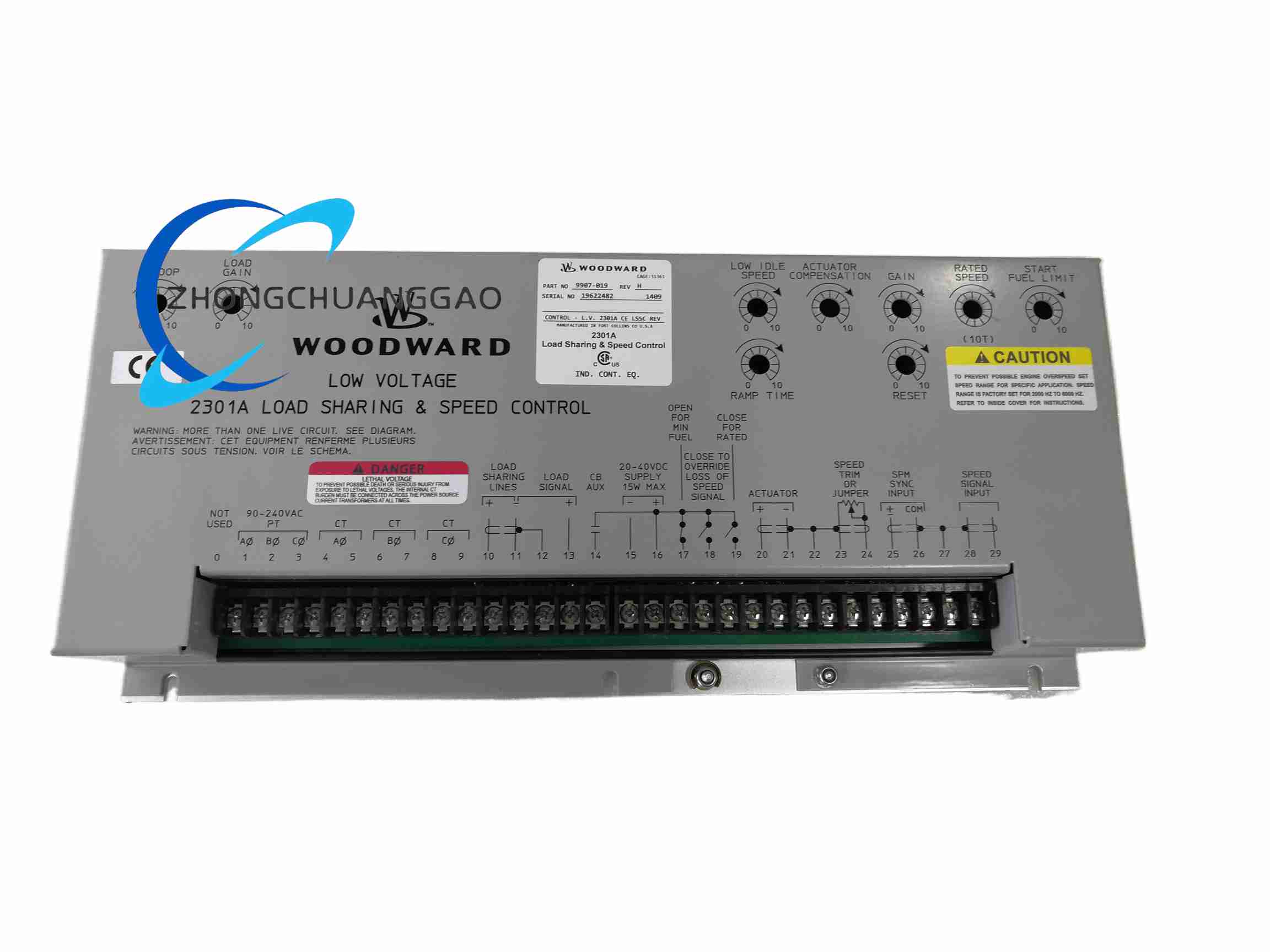
The Woodward 9907-019 is a low-voltage, reverse-acting electronic load sharing and speed control unit belonging to the 2301A series. It operates from a 20–40 V DC supply and drives a single actuator with reverse action (actuator moves toward fuel decrease on speed increase). It is designed for prime movers where a reverse-acting governor is required, with no speed ramp feature.
Description
Technical Specifications
-
Supply Voltage: 20–40 V DC
-
Action: Reverse acting (single actuator)
-
Actuator Current: 0–200 mA
-
Speed Ramp: Not provided
-
Dimensions: 387.35 mm × 180.975 mm × 63.5 mm
-
Weight: 1.758 kg
-
Operating Temperature: −40 °C to +85 °C
-
Storage Temperature: −40 °C to +70 °C
-
Standard: CSA certified; CE compliant
Functional Features
-
Reverse-acting control: on speed loss, actuator positions to start-fuel level.
-
Single-actuator control without speed ramp.
-
Precision load sharing and speed control.
-
Sturdy metal chassis for harsh industrial environments.
-
Wide operating temperature range.
Application Scenarios
Industrial prime movers, including turbines and engines, where reverse-acting governor action is required and paralleling with other generators is needed under the 2301A load sharing scheme.
Working Principle
The unit receives speed signal from a magnetic pickup, compares to the setpoint, and drives a single reverse-acting actuator. On speed increase, actuator decreases fuel; on speed decrease, actuator increases fuel. For load sharing, it communicates with other 2301A units via the load-sharing line.
Installation Requirements
-
Install in accordance with the Woodward 9905/9907 series manual.
-
Provide 20–40 V DC power supply.
-
Connect speed sensor and actuator wiring using shielded cables.
-
Connect load-sharing and droop contact lines as per plant wiring diagram.
-
Set speed range and calibrate start-fuel potentiometer.
Usage Precautions
-
On speed signal loss, verify actuator positions at start-fuel level.
-
Adjust start-fuel potentiometer counterclockwise to disable start-fuel limit if needed.
-
Observe ESD precautions during handling.
-
Do not operate outside −40 °C to +85 °C.
-
Follow commissioning procedure in the 2301A manual.
Reviews
There are no reviews yet.