
Product Short Description
Product Name
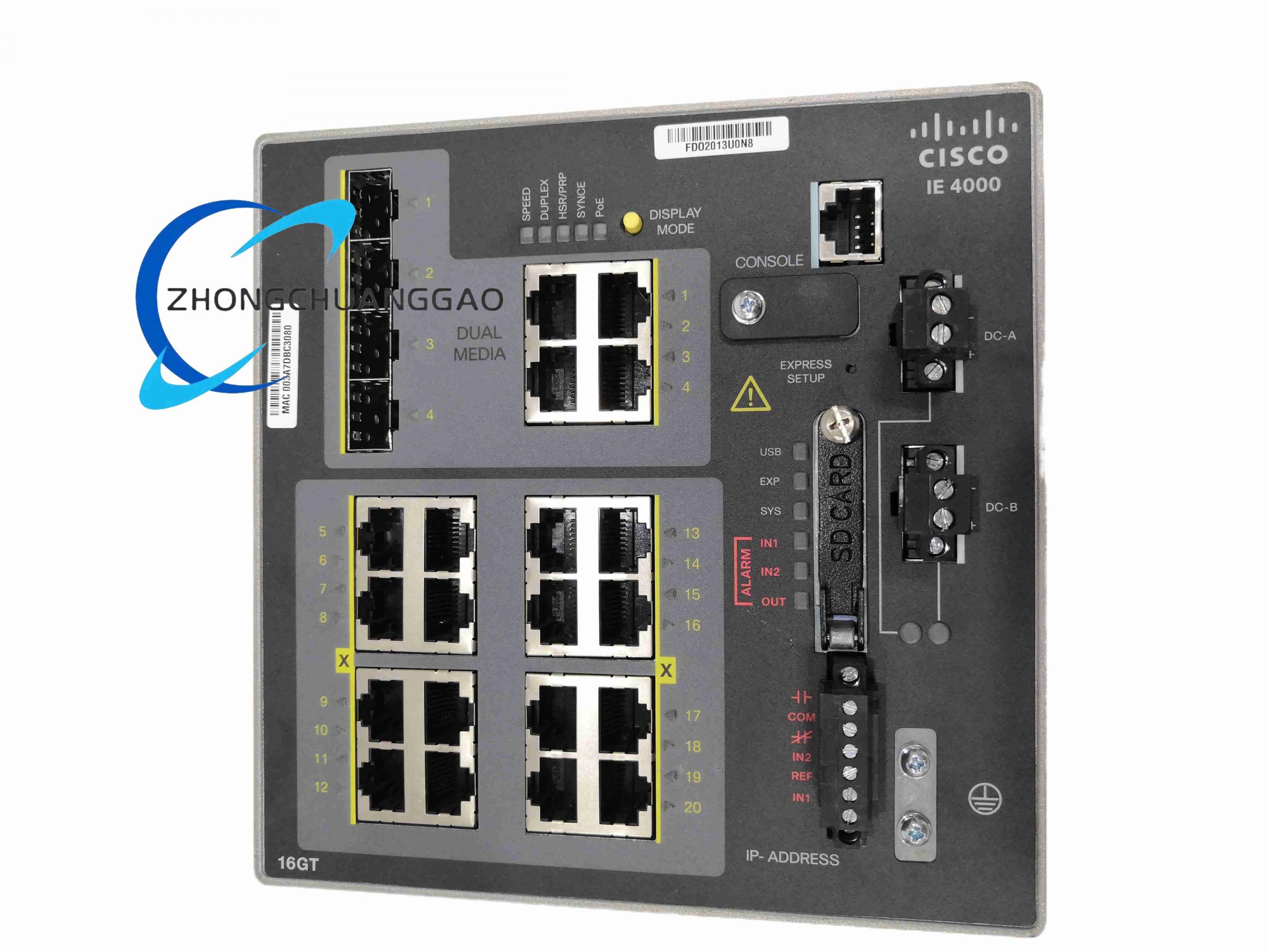
Cisco Industrial Ethernet 4000 Series managed switch with sixteen Gigabit copper access ports and four Gigabit combo uplinks.
Product Introduction
The switch delivers hardened Layer 2 industrial Ethernet switching for factory floor, energy, transportation, and substation networks. It runs Cisco IOS with LAN Base feature set, supports redundant ring and industrial automation protocols, and provides Gigabit access plus fiber or copper aggregation through combo uplinks.
Description
Technical Specifications
Total ports: twenty Gigabit Ethernet ports.
Access ports: sixteen 10/100/1000BASE-T RJ45 copper ports.
Uplink ports: four Gigabit combo ports, each combinable as RJ45 or SFP, with only one medium active per combo.
Switching capacity: twenty Gbps nonblocking on IE 4000 Series platforms.
Default software: LAN Base; upgradable software paths available per Cisco licensing.
Memory: one GB DRAM, one hundred twenty-eight MB onboard flash, one GB removable SD card.
Management ports: RJ45 console, mini USB console, alarm I/O.
Alarm I/O: two dry-contact alarm inputs, one alarm relay output.
Power input: redundant DC input, nominal nine point six to sixty VDC, maximum four point three A input current.
Power consumption: approximately forty W typical maximum for this model configuration.
Dimensions: six point one two inches high by six point one two inches wide by five point zero nine inches deep, equal to one hundred fifty-five point four millimeters by one hundred fifty-five point four millimeters by one hundred twenty-nine point two millimeters.
Weight: six point three five pounds, equal to two point eight eight kilograms.
MAC table: sixteen thousand unicast addresses.
VLAN scale: one thousand VLANs on the stated LAN Base configuration.
IGMP groups: one thousand groups.
Egress queues: four hardware egress queues.
Jumbo frames: supported up to eight thousand nine hundred ninety-six bytes on the stated configuration.
Functional Features
VLAN, private VLAN, voice VLAN, QinQ, STP, RSTP, MSTP, and spanning-tree guards.
Resilient ring and redundancy with REP, PRP, HSR, MRP, EtherChannel, and Flex Links.
Industrial protocol support for EtherNet/IP CIP, PROFINET version 2, Modbus TCP, and IEEE 1588 PTP.
Security with 802.1X, MAC Authentication Bypass, port security, DHCP snooping, dynamic ARP inspection, IP source guard, ACLs, SNMPv3, SSH, TACACS+, RADIUS, secure boot, and image signing.
Quality of service with ingress policing, egress queuing, AutoQoS, and PROFINET QoS.
Management through CLI, web device manager, SNMP, syslog, Cisco Industrial Network Director, Zero-Touch Replacement, SD-card configuration backup, and USB console.
Application Scenarios
Manufacturing cell and MES edge networking.
Power substation and utility automation using IEC 61850-class hardware environments.
Intelligent transportation, rail, and roadside controller networks.
Oil and gas, water treatment, and remote industrial sites requiring DC-powered redundant switches.
Machine builder cabinet Ethernet backbones with fiber uplinks.
Performance Parameters
All ports forward at line rate for all packet sizes on the stated IE 4000 configuration.
Sixteen copper ports provide independent Gigabit access for PLCs, HMIs, cameras, and I/O heads.
Four combo uplinks support short-reach multimode, long-reach single-mode, or copper aggregation depending on installed SFP.
Redundant DC inputs maintain operation during one power feed loss.
Ring protocols reduce convergence time compared with standard STP in deterministic automation networks.
Materials And Construction
Metal industrial enclosure suited for control cabinet or DIN-rail installation.
Fanless convection cooling design on the stated rugged configuration.
Conformal-coated PCB options and shock- or vibration-hardened components depending on certified variant.
RJ45 magnetics, SFP cages, terminal-block DC power connectors, and SD/USB service interfaces.
Working Principle
Incoming Ethernet frames are received on copper or SFP ports and classified by VLAN, QoS, and security policy. The switching fabric forwards frames at line rate between access and uplink ports. Control plane software exchanges topology, redundancy, and automation protocol information with neighboring switches and controllers. Alarm inputs monitor external dry contacts, while the relay output reports local power, port, or environmental faults to the automation system.
Installation Requirements
Mount on DIN rail or panel location with clearance for ventilation and cable bending radius.
Connect dual DC power feeds to the terminal block using correctly rated conductors and torque values.
Install only supported SFP modules; activate either RJ45 or SFP per combo port, never both simultaneously.
Configure VLAN, redundancy protocol, and industrial protocol profiles before connecting automation devices.
Ground the chassis and use shielded cabling where the site EMC and lightning-risk assessment requires it.
Usage Precautions
Use only Cisco-supported SFP transceivers for the installed software release.
Do not exceed the nine point six to sixty VDC redundant input range.
Avoid mixing alarm-input dry contacts and relay-output loads without confirming voltage and current ratings.
Back up the configuration and SD image before firmware upgrade.
Verify ring protocol compatibility with all neighboring switches to prevent network loops or convergence issues.
Reviews
There are no reviews yet.