
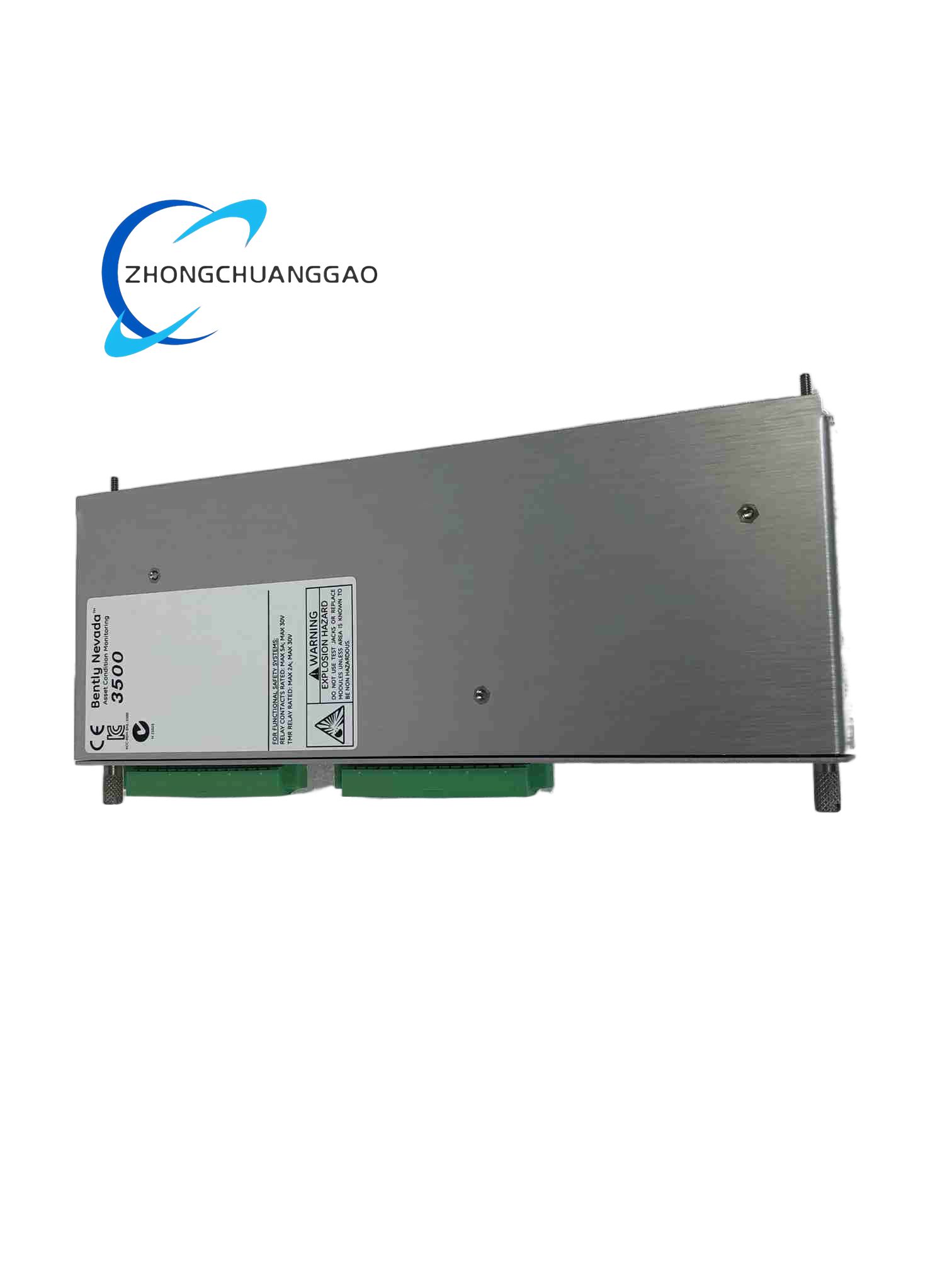
Description
-
Helps identify imbalance, misalignment, bearing defects, and mechanical looseness.
-
Designed for integration with industrial monitoring and protection systems.
Technical Specifications
-
Manufacturer: Bently Nevada, part of Baker Hughes
-
Model: 113819-01
-
Measurement Type: Vibration sensing or 4-20 mA vibration transmission depending on configuration
-
Frequency Range: 2 Hz to 10 kHz reported
-
Sensitivity: 100 mV/g reported
-
Measurement Range: ±50 g reported
-
Output Signal: 4-20 mA two-wire output reported in distributor listings
-
Temperature Range: -55°C to +120°C reported
-
Compliance Standards: IEC 60068-2-6, IEC 60068-2-64, IEC 60068-2-27 reported
Functional Features
-
Converts machinery vibration into standardized output signal.
-
Enables continuous monitoring of rotating equipment.
-
Supports predictive maintenance strategies.
-
Industrial ruggedized design for harsh environments.
-
Compatible with condition monitoring and protection systems.
Application Scenarios
-
Turbines
-
Compressors
-
Pumps
-
Generators
-
Motors
-
Fans and blowers
-
Oil and gas facilities
-
Power generation plants
-
Heavy industrial machinery
Material and Structural Characteristics
-
Industrial transducer housing suitable for machinery mounting.
-
Two-wire loop-powered design reported for 4-20 mA versions.
-
Robust construction for vibration, shock, and temperature exposure.
-
Mounting base or threaded interface for machine surface attachment.
Working Principle
-
Internal sensing element responds to mechanical vibration.
-
Vibration acceleration is converted into electrical signal.
-
Output may be directly proportional to vibration amplitude depending on configuration.
-
The 4-20 mA signal transmits measured vibration to monitoring systems.
-
Control room equipment interprets data for alarm, trend, and diagnostic purposes.
Installation Requirements
-
Mount directly on clean, flat machinery surface.
-
Use correct mounting torque and interface hardware.
-
Route signal cable away from high-voltage conductors.
-
Use shielded cable and proper grounding practice.
-
Verify measurement range and sensitivity before commissioning.
-
Calibrate or benchmark baseline vibration after installation.
Usage Precautions
-
Do not install beyond rated temperature and vibration limits.
-
Avoid cable damage from moving parts or sharp edges.
-
Prevent moisture ingress at junction points.
-
Establish baseline readings during healthy machine operation.
-
Investigate sudden changes in vibration trend immediately.
-
Perform periodic inspection of mounting integrity.
Reviews
There are no reviews yet.