
Product Short Description
Product Introduction:
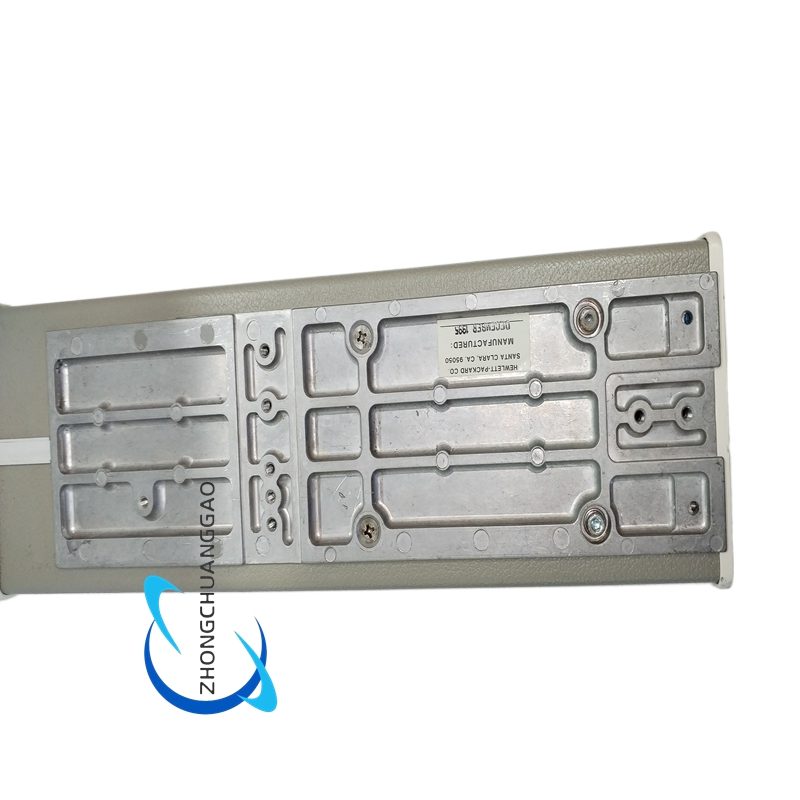
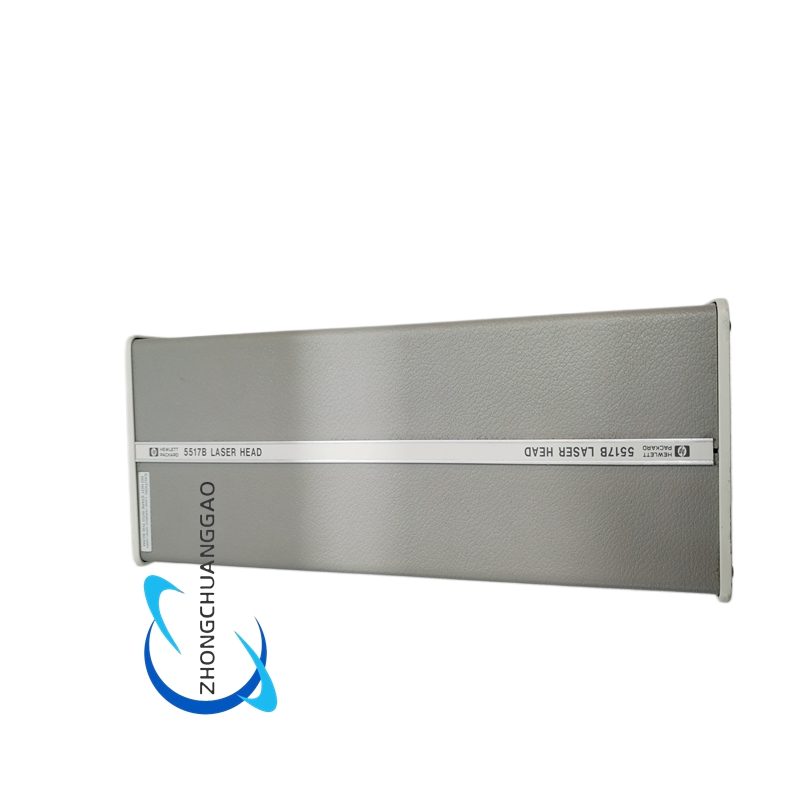
The Agilent 5517B is a laser measurement system designed for ultra-high-accuracy linear displacement, velocity, and vibration metrology. It serves as a primary standard in calibration laboratories, precision manufacturing, and research institutions. The system employs dual-frequency laser interferometry to achieve sub-nanometer resolution over extended measurement ranges.
Description
Technical Specifications:
- Laser Type: Dual-frequency Helium-Neon (HeNe) laser
- Laser Wavelength: 632.991 nm (in vacuum, frequency-stabilized)
- Measurement Range (Displacement): Up to 60 meters with optional retroreflector
- Resolution: 0.1 nm (1 Ångström)
- Velocity Measurement Range: 0 to 10 m/s
- Velocity Resolution: 0.1 nm/s
- Accuracy (Linear Displacement): ±0.5 ppm of measured value + 1 nm
- Accuracy (Velocity): ±0.5 ppm of measured value + 1 nm/s
- Output Signal: Quadrature sine/cosine signals (A, B, Z), TTL compatible
- Reference Frequency Output: 10 MHz (disciplined to laser frequency)
Functional Features:
- Dual-Frequency Interferometry: Eliminates direction ambiguity and enables absolute distance measurement
- Real-Time Velocity Measurement: Simultaneous displacement and velocity output from a single laser beam
- Continuous Measurement Mode: Supports uninterrupted tracking of moving targets
- Quadrature Output (A/B/Z): Enables bidirectional counting and homing detection
- 10 MHz Reference Output: Provides a frequency-stabilized reference for external instruments
- Internal Frequency Counter: Built-in high-resolution frequency measurement for velocity calculations
- Analog Output Option: Proportional analog voltage output for velocity or displacement
- RS-232 / GPIB Interface: Supports remote control and data acquisition integration
Performance Parameters:
| Parameter | Value |
|---|---|
| Laser Wavelength (Vacuum) | 632.991 nm |
| Laser Power Output | ≥1.5 mW (typical) |
| Beam Diameter (at exit) | ~0.8 mm |
| Beam Divergence | <1.5 mrad |
| Polarization | Linear (vertical) |
| Frequency Stability | ±1 ppm over 24 hours |
| Warm-Up Time | <30 minutes to full specification |
| Operating Temperature Range | 15°C to 35°C (59°F to 95°F) |
| Storage Temperature Range | -20°C to 60°C (-4°F to 140°F) |
| Relative Humidity | 20% to 80% (non-condensing) |
| Power Supply | 100-240 VAC, 50/60 Hz, 50W maximum |
| Dimensions (L×W×H) | Approximately 450 × 200 × 150 mm |
| Weight | Approximately 8 kg (17.6 lbs) |
Material Composition:
- Laser Tube Housing: Stainless steel with hermetic sealing
- Optical Bench: Zerodur or ULE ultra-low expansion glass-ceramic
- Optical Mounts: Invar (nickel-iron alloy) for thermal stability
- Housing Chassis: Aluminum alloy with anodized finish
- Beam Splitter: Dielectric-coated fused silica
- Polarizing Elements: Glan-Thompson or Glan-Laser calcite prisms
- Detectors: Silicon photodiodes with low-noise transimpedance amplifiers
Structural Features:
- Compact All-in-One Design: Laser head, interferometer optics, and electronics integrated in a single unit
- Internal Optical Path: Fully enclosed to prevent air turbulence and dust contamination
- Adjustable Beam Exit Port: Allows alignment flexibility for retroreflector positioning
- Front Panel Controls: Power switch, status LEDs, signal output connectors
- Rear Panel Connectors: RS-232, GPIB (IEEE-488), analog output, power input, trigger I/O
- Vibration Isolation Mounts: Rubber grommets on chassis base for lab bench mounting
Working Principle:
The Agilent 5517B operates on the principle of dual-frequency laser interferometry. Two orthogonally polarized frequencies (f1 and f2, typically separated by ~1.5 MHz) are generated within the HeNe laser cavity using a Zeeman splitter or acousto-optic modulator. The two frequencies travel along the same optical path and reflect off a moving retroreflector. The frequency difference (beat frequency) between the reference and measurement beams is detected by a photodetector. The beat frequency is directly proportional to the velocity of the retroreflector. Integration of the velocity signal yields displacement. The quadrature (A/B) signals are generated by splitting the beat signal into two channels with a 90° phase shift, enabling direction discrimination. The Z (index) pulse provides a once-per-fringe reference for absolute position homing.
Advantages and Highlights:
- Nanometer-Level Resolution: 0.1 nm resolution enables detection of sub-angstrom displacements
- Dual-Frequency Design: Immune to air turbulence and refractive index fluctuations compared to single-frequency systems
- Simultaneous Displacement and Velocity: No need for separate instruments for position and speed measurement
- Long Measurement Range: Up to 60 meters with appropriate retroreflector, exceeding most competing systems
- 10 MHz Stabilized Output: Serves as a primary frequency reference for other metrology equipment
- Low Drift: Frequency stability of ±1 ppm/24h ensures long-term measurement reliability
- Factory Calibrated: Ships with NIST-traceable calibration certificate
- Robust Design: All-metal optical bench with thermal compensation ensures stability in lab environments
Applicable Industries:
- Semiconductor Manufacturing: Wafer stage positioning, lithography alignment
- Precision Machine Tools: CNC machine calibration, linear encoder verification
- Aerospace and Defense: Structural testing, vibration analysis, inertial navigation calibration
- Calibration Laboratories: National metrology institutes (NMI), accredited calibration labs
- Scientific Research: Gravitational wave detection, atomic force microscopy, surface profilometry
- Automotive: Engine vibration testing, chassis dynamometer calibration
- Optical Manufacturing: Lens positioning, interferometer calibration
Model Series:
| Model | Description |
|---|---|
| Agilent 5517A | Single-axis laser measurement system, predecessor to 5517B |
| Agilent 5517B | Dual-frequency laser measurement system (current model) |
| Agilent 5528A | Multi-axis laser measurement system (4-axis variant) |
| Agilent 5529A | High-speed multi-axis laser measurement system |
| Keysight 5517B | Rebranded version after Agilent spinoff (same hardware) |
Installation Requirements:
- Optical Table or Vibration-Isolated Bench: Mount on a table with <1 μm/s² vibration level
- Clean Environment: ISO Class 7 or better (Class 10,000) recommended to prevent dust on optics
- Temperature Control: Maintain ambient temperature within 20°C ± 0.5°C for highest accuracy
- Retroreflector Alignment: Beam must be aligned to retroreflector within ±5 mrad angular tolerance
- Cable Routing: Keep signal cables away from high-current power lines to avoid EMI
- Grounding: Connect chassis ground to building earth ground
- Warm-Up: Allow minimum 30 minutes warm-up before precision measurements
Usage Precautions:
- Do not expose the laser beam to eyes: Class 3A laser, maximum output 1.5 mW, direct eye exposure is hazardous
- Never look directly into the beam exit aperture or retroreflector return beam
- Avoid touching optical surfaces: Fingerprint oils degrade coating performance permanently
- Do not operate in high-humidity environments (>80% RH): Condensation on optics causes measurement errors
- Do not move the unit during measurement: Internal optical alignment is sensitive to shock and vibration
- Do not disassemble the laser head: Sealed HeNe tube requires factory service only; tube life is ~20,000 hours
- Calibrate annually: Send to Agilent/Keysight authorized service center for recalibration to maintain NIST traceability
- Use only Agilent/Keysight specified retroreflectors: Third-party retroreflectors introduce alignment and Abbe error
- Allow warm-up before each use: Frequency stabilization requires ≥30 minutes at ambient temperature
- Store with beam port capped: Use the provided protective cap when not in use to prevent dust ingress
-500x500.jpg)
Reviews
There are no reviews yet.