
Product Short Description
Technical Specifications
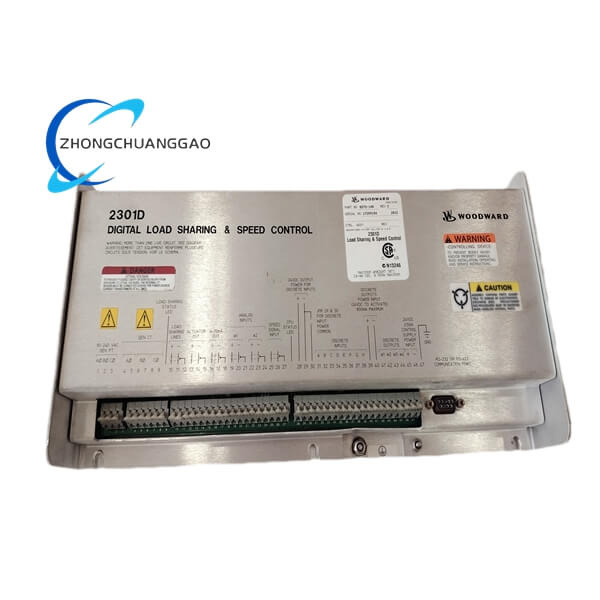
- Microprocessor-Based Design: Runs on Woodward’s proprietary real-time operating system for millisecond-level response.
- Input/Output Configuration:
- Analog Input: 1 channel (e.g., 4–20 mA for speed reference).
- Analog Output: 1 channel (e.g., 4–20 mA for fuel valve control).
- Digital Input: 1 channel (e.g., emergency stop signal).
- Digital Output: 1 relay contact (e.g., for trip/alarm signaling).
- Expansion Capability: Supports additional I/O modules via MicroNet Plus backplane bus.
- Communication: Built-in Modbus RTU (RS-485) for data exchange with external systems.
- Power Supply: 24 VDC (standard configuration).
- Operating Temperature: 0°C to +55°C (32°F to 131°F).
- Enclosure: IP20-rated (protected against solid objects >12.5 mm).
- Dimensions: 166 mm (L) × 112 mm (W) × 36 mm (H).
- Weight: Approximately 375 g.
Description
Key Features
- PID Control: Proportional-Integral-Derivative algorithms for stable speed regulation with minimal overshoot.
- Multi-Variable Monitoring: Reads redundant speed sensors (magnetic pickups or Hall-effect devices) and process variables (oil pressure, water temperature, air intake pressure).
- Protection Logic: Built-in safety functions include overspeed trip, low oil pressure shutdown, and high water temperature alert.
- Flexible Configuration: Software-adjustable parameters via Woodward’s iTools or ProDigi Suite engineering tools, enabling customization for engine speed ranges, gear ratios, and direction of action.
- Remote Management: Uploads operational data, alarms, and historical trends to central monitoring systems for predictive maintenance.
- Hot-Swappable Design: Modules can be replaced without interrupting system operation.
Functional Highlights
- Load Sharing: Distributes power evenly across multiple generators in parallel operation.
- Synchronization: Aligns phase and frequency for grid connection or islanded microgrids.
- Startup Sequence Control: Manages timed activation of auxiliary systems (e.g., lubrication pumps, cooling fans).
- Emergency Stop: Initiates fuel cutoff and mechanical braking within milliseconds upon detecting critical faults.
- Diagnostic Tools: Captures waveform data and event logs to troubleshoot control loop performance.
Application Scenarios
- Power Generation: Controls gas turbines, steam turbines, and diesel generators in thermal power plants, cogeneration facilities, and renewable energy systems (e.g., biomass, geothermal).
- Oil & Gas: Safeguards compressor turbines on offshore platforms and pipeline stations, ensuring stable pressure regulation during drilling and processing.
- Marine Propulsion: Manages engine speed for shipboard generators and propulsion systems, optimizing fuel efficiency and reducing emissions.
- Industrial Automation: Regulates mechanical equipment (e.g., pumps, fans, conveyors) in manufacturing, mining, and chemical plants to enhance productivity and product quality.
- Distributed Energy: Stabilizes microgrids by balancing load demand with supply from solar, wind, or diesel sources.
Advantages
- High Reliability: Designed for 24/7 operation in extreme conditions (vibration, shock, electromagnetic interference).
- Scalability: Supports small-scale standalone systems or large-scale distributed networks with hundreds of nodes.
- Ease of Integration: Compatible with third-party devices and protocols, reducing deployment complexity.
- Cost Efficiency: Reduces downtime through proactive fault detection and remote diagnostics.
- Compliance: Meets international standards such as IEC 61508 SIL-2 for functional safety and ATEX/IECEx for hazardous environments.
-500x500.jpg)
Reviews
There are no reviews yet.