
Product Short Description
Technical Specifications
- Electrical Specifications
- It adopts a 24V DC power supply, which is consistent with the power supply standard of most industrial on-site equipment and facilitates on-site power configuration.
- It is equipped with a 32-bit Motorola MPC860 processor with a clock speed of 50 MHz, which provides strong computing power for complex control logic operations.
- It is configured with 6MB flash PROM for storing system programs and control applications, 16MB DRAM for running control applications and storing sequence of events data, and 8KB NVRAM for storing retentive variables.
- It uses a half-AA lithium battery with an expected service life of 15 years to ensure the stable operation of the built-in clock and the retention of key data when the external power supply is cut off.
- Physical Specifications
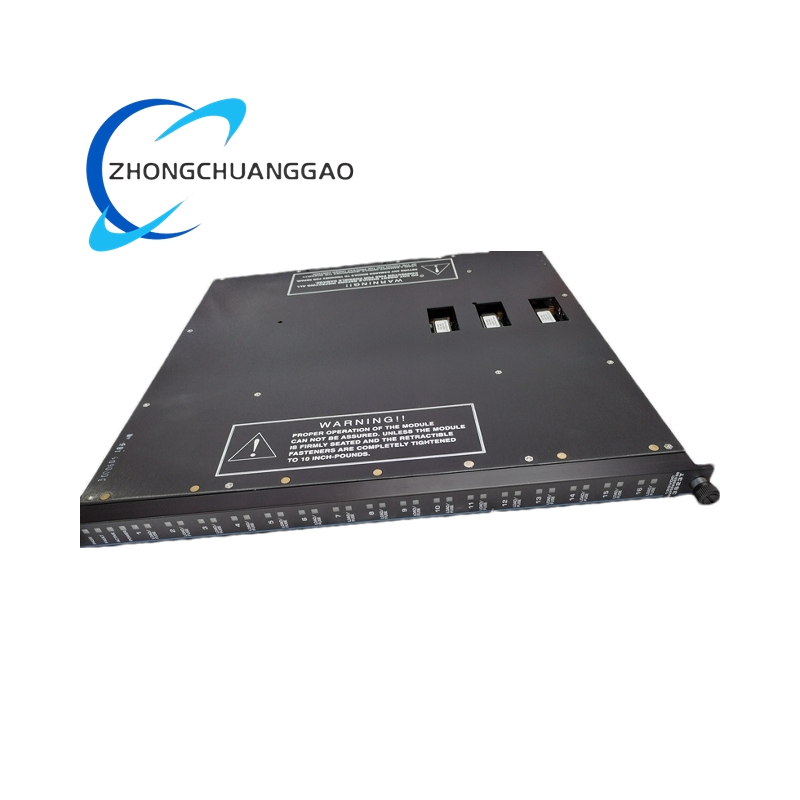
- The overall dimensions are approximately 22cm × 16.9cm × 4.4cm and the weight is about 1 kilogram, and its compact size is convenient for installation in the Triconex rack.
- It adopts a modular plug-in installation method, which can be quickly installed and fixed with the system rack without complicated assembly procedures.
- It is equipped with multiple interface connectors, including a shielded 10BaseT RJ-45 Ethernet connector and a shielded DB-9 pin connector for RS-232/485 DTE.
Description
- Environmental Specifications
- The operating temperature range is -40°C to 70°C, which can adapt to the extreme temperature environment of various industrial sites such as cold workshops and high-temperature chemical plants.
- It can work normally in an environment with a relative humidity of 5% – 95% without condensation, and is not prone to performance degradation due to moisture.
- It can maintain stable performance in harsh industrial environments with electromagnetic interference and mechanical vibration, and is not affected by external environmental factors to cause operation errors.
Functional Characteristics
- High Reliability Based on Redundant Architecture
- The triple modular redundancy design and 2-out-of-3 voting mechanism fundamentally eliminate single points of failure. When a fault occurs in one of the channels, the system can automatically rely on the other two normal channels to work, which ensures the continuous and stable operation of the system and meets the SIL3 safety integrity level requirements.
- The CRC-protected Tribus communication bus is used between internal components, and the RS-485 HDLC communication rate between processor channels reaches 2 Mbps, which ensures the accuracy and efficiency of internal data transmission and avoids data loss or errors.
- Powerful Processing and Communication Capabilities
- The 50 MHz 32-bit processor can quickly process a large amount of on-site I/O data and complex control algorithms, enabling the emergency shutdown system and safety interlock to respond to on-site abnormal events in real time.
- It is equipped with multiple communication interfaces such as Ethernet, RS-232, Modbus ports and debug ports. It can seamlessly communicate with distributed control systems, human-machine interfaces and SCADA systems, realizing efficient data interaction between the module and various external devices.
- Comprehensive Diagnostics and Easy Maintenance
- It has complete self-test and online diagnostic functions, which can quickly detect and isolate faults inside the module and external connection faults, and feed back fault information to the upper monitoring system in a timely manner.
- It supports hot-swappable operation. When maintenance is required due to a fault, the module can be replaced online without shutting down the entire control system, which greatly shortens the maintenance time and reduces production losses caused by shutdown.
- The clock calendar has high accuracy. The typical error is 1 second per day when powered on, and the maximum error does not exceed 2.2 seconds per day, which provides accurate time stamps for event recording and facilitates subsequent fault traceability.
Application Scenarios
- Oil and Gas Industry
- It is used as the core component of emergency shutdown systems and fire and gas systems on offshore and onshore drilling platforms. It monitors parameters such as oil and gas pressure and flow in real time and immediately triggers the shutdown procedure when abnormal data is detected to prevent leakage and explosion accidents.
- It is deployed in long-distance oil and gas pipeline control systems to connect with remote valve stations and leak detection equipment, process monitoring data in a timely manner and issue valve switch commands to ensure the safety of oil and gas transportation.
- Chemical and Petrochemical Industry
- It is integrated into the control system of chemical reactors and storage tanks. It monitors the temperature, pressure and liquid level of the reactor during the production process and adjusts the operation parameters in real time to avoid dangerous reactions caused by process deviations.
- It is applied to the combustion management system of petrochemical plants to control the ignition and combustion process of burners and ensure that the combustion process is carried out within a safe range to prevent fire accidents.
- Power Industry
- In nuclear power plants, it is used in the safety monitoring system of nuclear reactors to monitor the operation status of key equipment and transmit data to the central control room in real time to ensure the safe and stable operation of the nuclear power system.
- In thermal power plants, it controls the overspeed protection of turbines and the safety interlock of boilers. When abnormal parameters such as excessive turbine speed are detected, it can quickly execute protective actions to avoid equipment damage.
- Other Critical Industrial Fields
- In the pharmaceutical industry, it is applied to the automated production lines of sterile drugs to control and monitor the mixing, sterilization and filling processes, ensuring that the production process complies with safety and quality specifications.
- In the metallurgical industry, it is integrated into the blast furnace control system to monitor the temperature and pressure of the blast furnace and control the feeding and air supply equipment to ensure the safe and efficient operation of the smelting process.
Be the first to review “Triconex TRI-GP3101S2 Main Processor Module” Cancel reply
Reviews
There are no reviews yet.