
Product Short Description
- Technical Specifications
- Electrical Parameters
- Input Channels: 32 differential and DC-coupled input channels
- Supported Signal Ranges: Compatible with 0 – 5 VDC unipolar voltage and -5 to +5 VDC bipolar voltage; supports 0 – 20 mA current signals when used with an external 250 Ω shunt resistor
- Resolution: Programmable 12-bit or 14-bit to meet different precision requirements of industrial scenarios
- Measurement Accuracy: Better than 0.15% of full scale within the temperature range of 0°C to 60°C
- Input Update Rate: 10 milliseconds, ensuring real-time transmission of collected data
- Input Resistance: Minimum 10 MΩ under normal DC operation; power-off resistance is typically 140 kΩ
- Common Mode Rejection Ratio: -85 dB from DC to 100 Hz, effectively suppressing common-mode noise
- Normal Mode Rejection Ratio: -3 dB at 23 Hz, -8 dB at 60 Hz, and -14 dB at 120 Hz
- Overvoltage Protection: Can continuously withstand 150 VDC or 115 VAC input to avoid damage from abnormal signal surges
- Physical Parameters
- Weight: 1.36 kilograms, facilitating installation and reducing chassis load
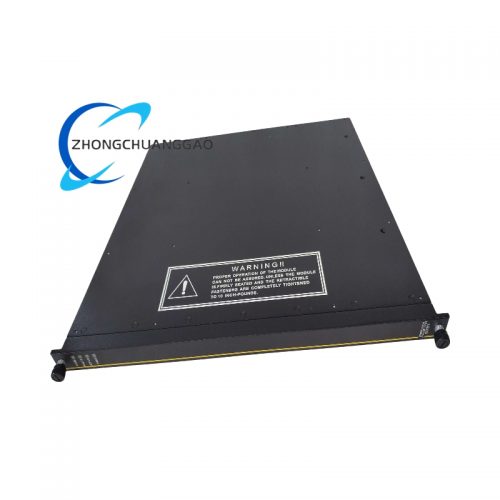
- Housing Color: Yellow, which is easy to distinguish from other modules in the system
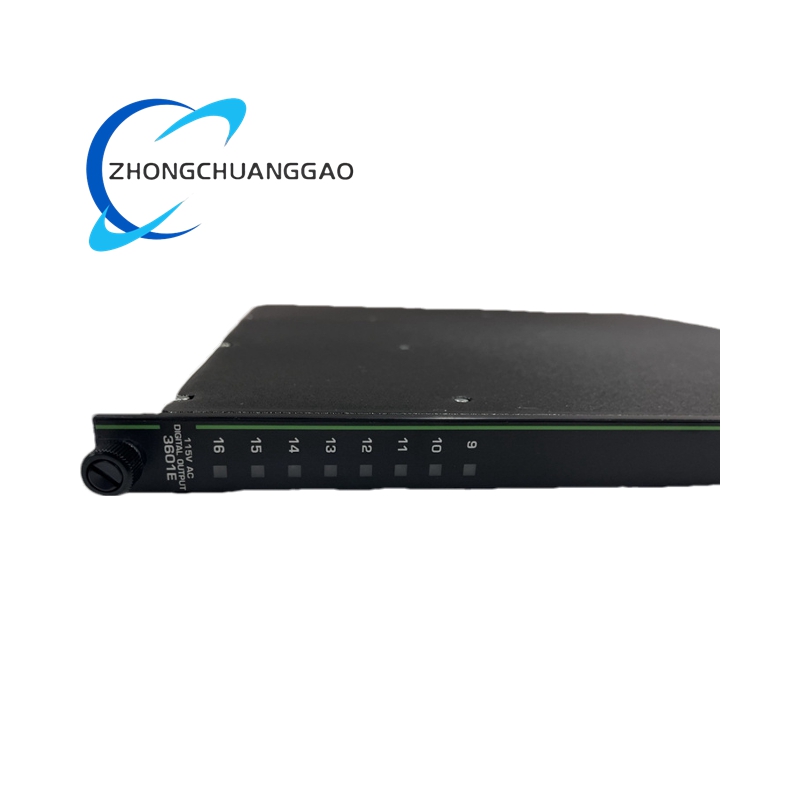
- Status Indicators: Equipped with pass, fault, active, and field indicators to display the module’s operating status in real time
- Environmental Parameters
- Operating Temperature: -40°C to 70°C, adapting to extreme temperature changes in industrial sites
- Operating Humidity: 5% – 95% non-condensing, preventing malfunctions caused by moisture erosion
- Electrical Parameters
Description
- Functional Features
- Triple Modular Redundancy Architecture: The module adopts a triple modular redundancy design. Three independent circuits perform signal collection and processing simultaneously, and the final effective data is determined through a voting mechanism. Even if one circuit malfunctions, the system can still maintain normal operation, completely avoiding the impact of single-point failures on the entire safety system.
- High-Density and Versatile Signal Acquisition: With 32 differential input channels, it can collect analog signals from a large number of field sensors at the same time, which is suitable for large-scale industrial systems that require multi-point monitoring. It supports both voltage and current signals, enabling flexible adaptation to different types of field sensing equipment.
- Strong Anti-Interference and Protection Capabilities: The differential measurement design and high common-mode rejection ratio can effectively filter out common-mode noise in industrial environments. The isolated input points prevent ground loop interference. Meanwhile, the overvoltage protection function can resist abnormal voltage impacts, ensuring the module’s stable operation in complex and harsh electrical environments.
- Convenient Maintenance and Identification: The yellow color-coded housing allows maintenance personnel to quickly locate the module in the complex system. The clear status indicators can directly reflect the module’s working state, helping staff promptly detect and troubleshoot faults. The modular structure also enables quick replacement without affecting the overall operation of the system.
- Precision-Adjustable Data Acquisition: The programmable 12-bit or 14-bit resolution allows users to adjust the data acquisition precision according to specific process requirements. This balances the precision needs of different industrial links and improves the adaptability of the module in various application scenarios.
- Application Scenarios
- Oil and Gas Industry: It is deployed in offshore drilling platforms and onshore oil transmission systems. It collects analog signals from pressure and flow sensors in oil and gas pipelines. When abnormal parameters are detected, it transmits signals to the safety system in a timely manner to trigger emergency shutdown measures and prevent accidents such as oil and gas leakage and explosion.
- Petrochemical Industry: Applied to chemical reactors and distillation towers, it collects real-time temperature and pressure signals during chemical reactions. It transmits accurate data to the control system to help adjust reaction conditions, avoiding violent reactions or product quality degradation caused by parameter deviations.
- Power Generation Industry: Installed in thermal power plants and nuclear power auxiliary systems, it monitors analog signals such as temperature and pressure of boilers, steam turbines and transformers. It ensures the control system can timely adjust the operation parameters of equipment, preventing equipment damage due to overheating and ensuring stable power output.
- Metallurgical Industry: Used in blast furnaces and steelmaking converters, it collects temperature and pressure signals in the smelting process. It provides data support for adjusting smelting parameters, ensuring the stability of molten steel quality and avoiding damage to furnace linings caused by local overheating.
- Renewable Energy Field: Applied in wind power and solar photovoltaic systems, it collects voltage and current signals from power generation equipment. It monitors the operating status of the power generation system in real time, helping optimize power conversion efficiency and ensuring the safe integration of renewable energy into the power grid.
- Pharmaceutical Industry: Integrated into pharmaceutical production lines, especially in processes such as high-temperature sterilization and drug mixing. It collects temperature and pressure signals in the equipment to ensure that each production link meets GMP standards and avoids batch drug quality problems caused by unstable process parameters.
Be the first to review “Triconex 3721 32-Channel Differential Analog Input Module” Cancel reply
Reviews
There are no reviews yet.