Product Short Description
Technical Specifications
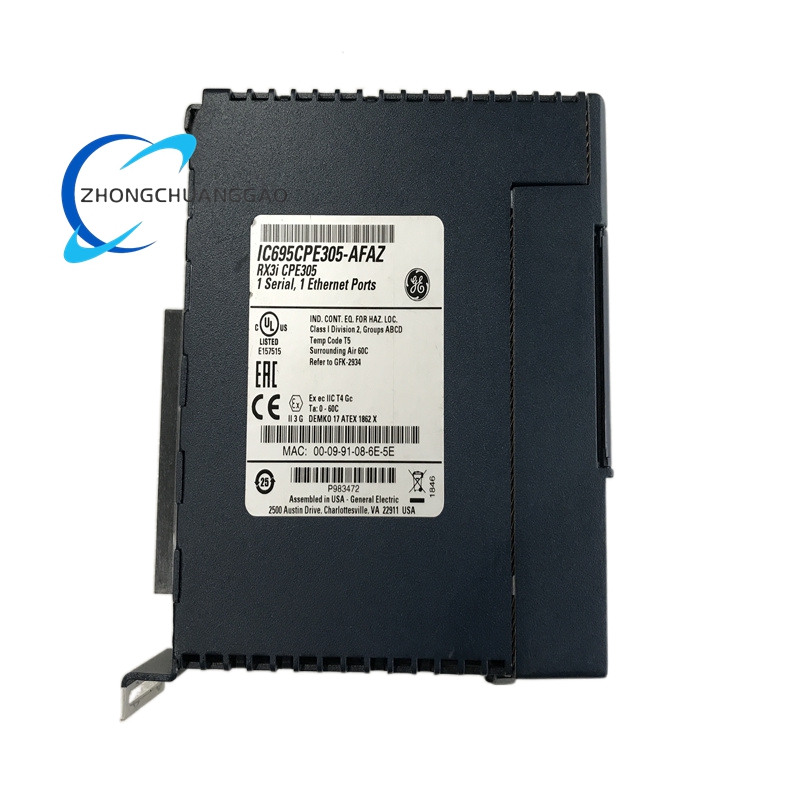
- Processor: 1.1 GHz CPU with 32-bit architecture
- Boolean Instruction Scan Speed: 0.72 ms per 1000 instructions
- Memory:
- 5 MB RAM for program execution and data caching
- 5 MB non-volatile user memory for program storage
- Communication Interfaces:
- 2x serial ports (RS232/RS485)
- 1x Ethernet port (10/100 Mbps) supporting protocols like Modbus TCP, EtherNet/IP, and OPC UA
- 1x USB 2.0 host port for program uploads/downloads
Description
- I/O Expansion: Supports up to 8 local racks via backplane or fiber-optic connections, accommodating a mix of digital/analog I/O modules
- Power Requirements:
- 5 V DC (1 A max)
- 3.3 V DC (1 A max)
- 24 V DC (0.5 A max)
- Environmental Tolerance:
- Operating Temperature: -10°C to 70°C (wide-temperature version available for -40°C to 85°C)
- Humidity: 10%–90% non-condensing
- IP30 protection rating (requires control cabinet for full environmental isolation)
Functional Characteristics
- High-Speed Processing: The 1.1 GHz processor enables millisecond-level logic operations, suitable for real-time control tasks like multi-axis synchronization and high-speed signal processing.
- Multi-Protocol Communication: Built-in Ethernet and serial ports support seamless integration with HMI, SCADA systems, and third-party devices. The module also extends compatibility to industrial networks like PROFIBUS, DeviceNet, and CANopen via expansion modules.
- Flexible Programming: Supports multiple IEC 61131-3 programming languages, including ladder logic, structured text, and function block diagrams, facilitating complex algorithm development.
- Modular Design: Allows hot-swapping of faulty modules to minimize downtime. Supports redundant configurations for enhanced system reliability.
- Security Features: Includes program encryption, user access controls, and fault self-diagnosis with alarm outputs for proactive maintenance.
Application Scenarios
- Industrial Automation: Controls robotic arms, conveyor systems, and assembly lines in automotive and electronics manufacturing, ensuring precise motion control and data acquisition.
- Energy Management: Integrates into smart grid systems for remote monitoring, fault diagnosis, and energy consumption optimization in power distribution networks.
- Process Control: Manages temperature, pressure, and flow parameters in chemical processing and oil/gas refining, supporting safe and efficient operations.
- Water Treatment: Monitors and adjusts pH levels, turbidity, and chemical dosing in wastewater treatment plants for compliance with environmental standards.
- Building Automation: Regulates HVAC systems, lighting, and security in smart buildings by interfacing with sensors for energy-efficient climate control.
Reviews
There are no reviews yet.