
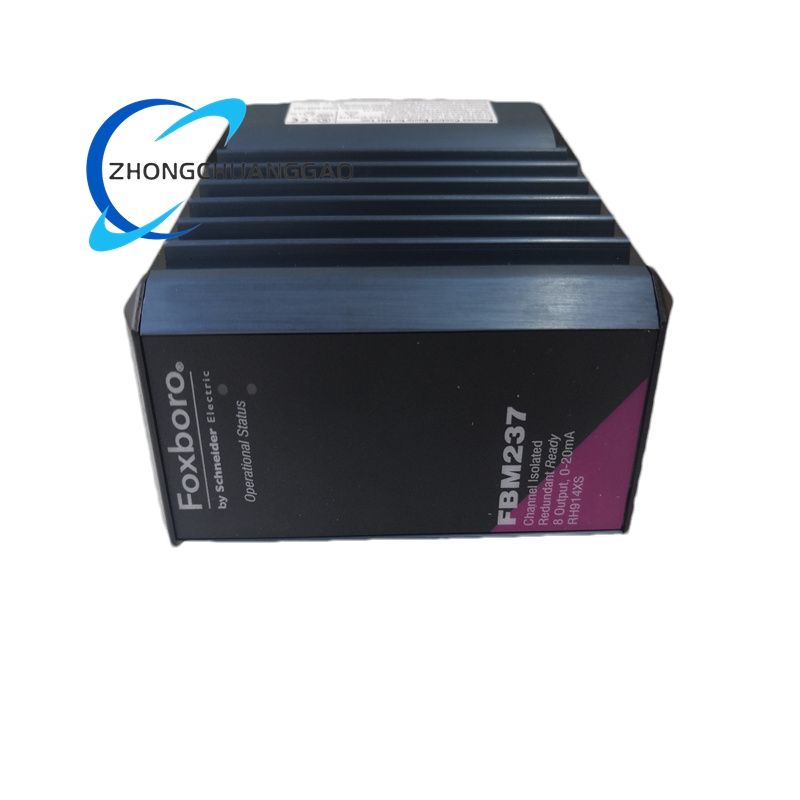
Product Short Description
Technical Specifications
- Output Parameters
- It has 8 independent galvanically isolated analog output channels, with an output signal range of 0 – 20.4 mA DC and compatibility with 4 – 20 mA DC industrial standard signals.
- The analog output accuracy linearity is ±0.05% of the full span within the 0.1 – 20 mA range, and the accuracy temperature coefficient is ±50 ppm/°C.
- The output resolution reaches 13 bits, the maximum output processing delay is 30 ms, and the maximum load that can be driven is 750 Ω.
- Electrical Specifications
- The module uses a 24V DC power supply, with a voltage tolerance of +5% and -10%.
- The maximum power consumption is 7W under the 24V DC power supply, and the maximum heat dissipation is 5W.
- The insulation resistance is 100 MΩ, and the dielectric strength reaches 1000V DC, which can effectively resist electrical interference.
Description
- Physical & Environmental Specifications
- The module weighs approximately 0.3 kg, with a compact structural design that is easy to install in control cabinets.
- The operating temperature ranges from -20°C to +70°C, and some matching termination assemblies can withstand a wider temperature range of -40°C to +85°C.
- The storage temperature of the matching termination assemblies can reach -40°C to +125°C, and it adapts to most industrial humidity environments without condensation.
Function Features
- Channel Isolation and High Signal Accuracy
Each of the 8 output channels adopts galvanic isolation technology, which completely isolates each channel from each other and from the ground. This design eliminates signal crosstalk between channels and prevents external electrical interference from affecting the output signal quality. With a 13 – bit resolution and a temperature coefficient of ±50 ppm/°C, the module maintains high output accuracy even when the ambient temperature changes, laying a foundation for precise control of field equipment such as actuators and valves.
- Redundant Configuration to Ensure Operational Continuity
The module supports redundant pairing configuration. In key industrial processes, two FBM237 modules work together. When one module malfunctions, the other immediately takes over its work without interrupting the output of control signals. This redundant design avoids unplanned downtime of the production process caused by module failures, greatly improving the reliability and stability of the entire control system.
- Compatibility and Convenient Maintenance
It is perfectly integrated with the Foxboro I/A Series DCS and is electrically compatible with HART protocol devices. It allows operators to debug parameters and read device status of HART – enabled field instruments without additional communication modules. The dedicated termination assemblies can be used with output bypass stations. During module maintenance, the bypass station maintains the continuous output of control signals, avoiding production fluctuations caused by maintenance operations.
- Rugged Structure and Strong Environmental Adaptability
The extruded aluminum housing gives the module strong impact resistance and corrosion resistance. It can operate stably in harsh industrial environments such as high dust, vibration and large temperature changes. It meets the installation and operation requirements of various harsh industrial sites, reducing the failure rate caused by environmental factors and extending the service life of the module.
Application Scenarios
- Petrochemical Industry
It is deployed in oil refineries and petrochemical plants, converting DCS digital signals into analog current signals to control the opening of control valves in reaction towers, distillation columns and other equipment, as well as the speed of delivery pumps. For example, it adjusts the opening of flow control valves according to the 4 – 20 mA signal to stabilize the flow of raw materials. The redundant configuration ensures that the control of key equipment will not be interrupted, preventing safety accidents such as material leakage and reactor overpressure caused by control signal loss.
- Power Industry
It is widely used in thermal power plants and nuclear power plants. It controls the opening of steam valves of turbines, the speed of induced draft fans and the feed flow of boilers. It converts the load adjustment signals from the central control system into analog signals to precisely regulate the operation parameters of these key equipment. The high accuracy and stability of the module ensure the stable output of electric power and help to improve the efficiency of power generation while reducing energy consumption.
- Pharmaceutical Industry
It is integrated into pharmaceutical production lines such as chemical synthesis and sterile filling. It controls the flow rate of dosing pumps, the pressure of reaction kettles and the speed of mixing equipment. For example, in the drug synthesis process, it precisely adjusts the dosing flow through analog signals to ensure the proportion of raw materials meets the formula requirements. Its high reliability and accuracy help enterprises comply with GMP production standards and ensure the stability and consistency of drug quality.
- Metallurgical Industry
It is applied in steelmaking and non – ferrous metal smelting workshops. It is connected to actuators and regulators of smelting furnaces, converters and rolling mill equipment. It controls parameters such as the oxygen supply flow of smelting furnaces and the pressure of rolling oil cylinders. The galvanic isolation design of the module resists electromagnetic interference from large – power electrical equipment on the production site, ensuring the stability of the smelting process and improving the quality of metal products.
- Water Treatment Industry
It is installed in urban sewage treatment plants and industrial wastewater treatment systems. It controls the speed of sewage lift pumps, the opening of chemical dosing valves and the aeration rate of aeration tanks. It converts the control commands from the water quality monitoring system into analog signals to adjust the operation of relevant equipment according to the real – time water quality data. This precise control ensures that the treated water meets the discharge standards and improves the efficiency of water treatment while reducing the consumption of chemicals.


Reviews
There are no reviews yet.