
Product Short Description
- Product Name
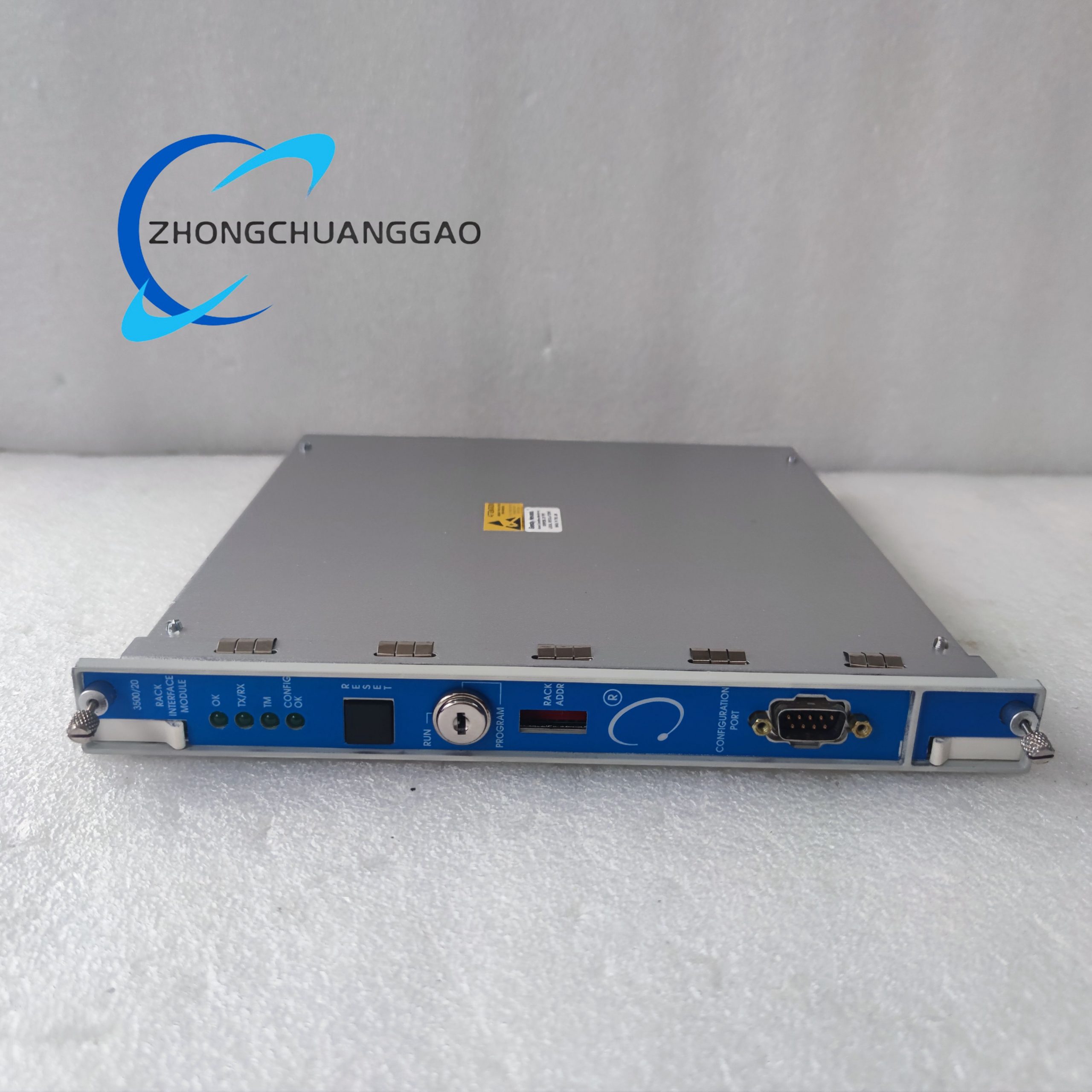
- Transient Data Interface (TDI) Module for Bently Nevada 3500 Series Machinery Protection System
- Product Introduction
This module belongs to the Bently Nevada 3500/22M series and acts as a critical connection component between the 3500 monitoring system and compatible software, including System 1 condition monitoring and diagnostic software and 3500 system configuration software. It integrates the functions of the 3500/20 Rack Interface Module and the data collection capability of communication processors such as TDXnet. It must be installed in the slot adjacent to the power supply of the 3500 rack and interfaces with M-series monitors to continuously collect steady-state and transient dynamic waveform data. The collected data is then transmitted to the host software via an Ethernet link. It serves as a cost-effective solution for general-purpose machinery and processes that benefit from continuous monitoring and protection, and does not interfere with the critical monitoring path of the overall system during operation.
Description
- Technical Specifications
- Input and Output Configuration: It is equipped with four sensor inputs and four temperature inputs. The sensor inputs support 2-wire and 3-wire accelerometers, velocity sensors or proximity sensors. The temperature inputs are compatible with E, J, K, and T-type thermocouples, as well as 2-wire or 3-wire RTDs. It also provides six relay outputs, four 4 – 20mA recorder outputs and one dedicated buffer output.
- Communication Parameters: It supports Ethernet and software-configurable RS232/485 serial ports for Modbus communication, and is also compatible with industrial standard protocols like Ethernet/IP and Profinet. The Modbus gateway option enables it to directly provide data to Modbus clients. Its frequency range covers 0 – 10 kHz, which meets the requirements of most industrial machinery vibration monitoring.
- Data Processing Performance: It adopts a 24-bit ADC conversion technology that ensures high-precision data conversion of collected signals. It has a 200-entry event list to store equipment operation events in chronological order, and uses non-volatile memory to permanently store configuration information.
- Physical Indicators: The module weighs 2.5 kilograms and has physical dimensions of 200mm × 150mm × 50mm. This compact size matches the installation dimensions of the 3500 series standard rack, facilitating seamless integration.
- Power Supply Requirement: It operates with an input voltage range of 100V – 240V AC, which is compatible with the power supply standards of various industrial sites and ensures stable operation under different power supply conditions.
- Function Features
- Integrated Dual-Core Functionalities: By combining the functions of the rack interface module and communication processor, it reduces the number of supporting components in the 3500 system, simplifies the overall system structure, and lowers the difficulty of system deployment and maintenance.
- Flexible Configuration Capabilities: Users can configure each sensor input, relay contact and recorder output through the 1900 configuration software. They can also set the relay to switch on or off according to the normal, alarm and dangerous states of channels, and output data of any variable from any channel through the recorder output.
- Diversified Communication Options: It supports multiple communication modes and protocols, enabling smooth data interaction with distributed control systems, SCADA systems, programmable logic controllers and System 1 software. Users can also upgrade the module without a Modbus gateway by purchasing a communication upgrade package.
- Auxiliary Operation Support: It supports optional displays/keyboards, allowing on-site personnel to view channel information and make minor configuration adjustments. The display can be installed up to 75 meters away from the module, which enhances operational convenience in large industrial sites.
- Self-Diagnosis and Redundancy: It has a monitor channel comparison function that can compare data between channels and send error indicators to the monitor. It also has network redundancy capabilities, which maintain the continuity and integrity of data transmission when some network components fail.
- Application Scenarios
- Power Generation Industry: It is widely used in thermal power, hydropower and nuclear power plants to monitor the operating status of key rotating machinery such as steam turbines, generators and coal mills. It collects vibration and temperature data in real time to help technicians detect potential faults early.
- Petrochemical Industry: It is deployed in refineries and chemical plants for monitoring compressors, pumps and gearboxes. It adapts to high-temperature and high-pressure on-site environments, captures transient operating data of equipment, and provides a reliable basis for equipment maintenance and fault diagnosis.
- General Manufacturing Industry: It is integrated into production lines with large machine tools, motors and fans. Its cost-effective advantage makes it suitable for large-scale application in general machinery monitoring, helping enterprises reduce maintenance costs and avoid unexpected production downtime.
- Oil and Gas Industry: It is installed on offshore drilling platforms and onshore oil transmission stations to monitor drilling machinery and pipeline pumps. It ensures stable data transmission in harsh environments such as high humidity and strong corrosion, which is crucial for the safety of oil and gas extraction and transportation.
- Metallurgical Industry: It is applied to the monitoring system of rolling mills and blast furnace auxiliary equipment in steel plants. It withstands harsh working conditions such as large temperature fluctuations and heavy dust, continuously collects equipment operation data, and guarantees the continuous and safe operation of metallurgical production lines.
Reviews
There are no reviews yet.