
Product Short Description
Product Introduction
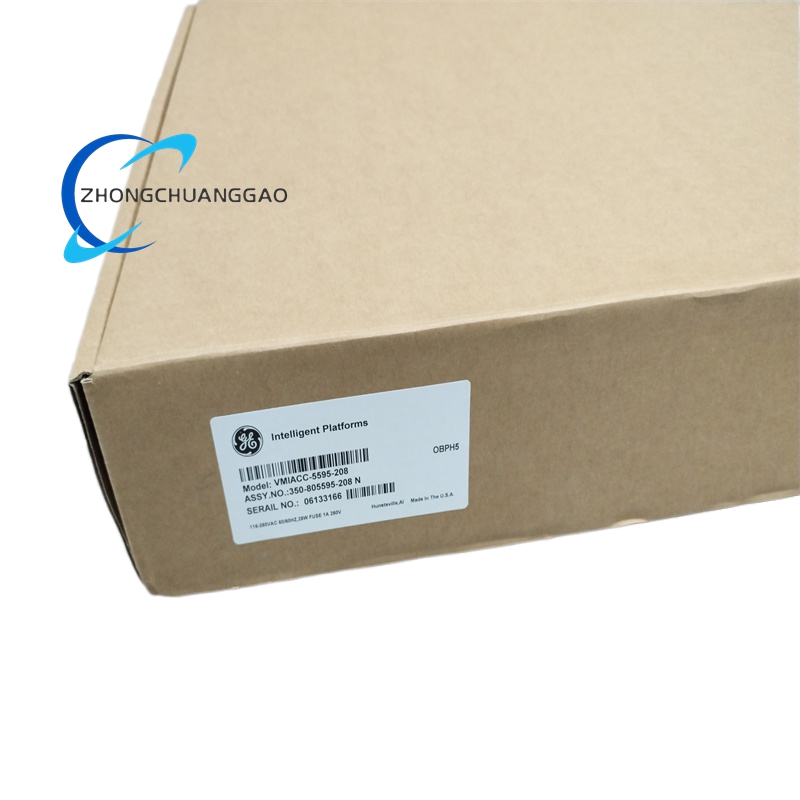
The GE VMIACC-5595-208 is a high-performance, managed reflective memory hub engineered for real-time, deterministic data sharing across distributed embedded systems. Designed exclusively for compatibility with the GE/Abaco Systems 5565 family of reflective memory products, this hub replaces traditional daisy‑chained loop topologies with a robust star‑configured network. It delivers 2 Gb/s fiber‑optic data transfer, automatic fault bypass, and signal regeneration to ensure ultra‑low‑latency, reliable communication between up to 256 networked nodes. Available in 1U rack‑mount or desktop form factors, it supports both short‑reach multimode and long‑reach single‑mode fiber via hot‑swappable SFP transceivers, making it ideal for mission‑critical applications requiring synchronized, real‑time data exchange.
Description
Technical Specifications
Core Performance
- Data Rate: 2 Gb/s (2.125 Gbps line rate)
- Throughput: Up to 174 MB/s sustained data transfer
- Latency: Deterministic node‑to‑node latency, typically 2.1 μs
- Fault Bypass: Automatic port bypass on signal/sync loss; switch time < 50 ms
- Signal Regeneration: Full optical signal regeneration per port to eliminate attenuation and jitter
Port & Connectivity
- Fiber Ports: 8 × SFP fiber‑optic ports (duplex LC)
- Multimode: 830–860 nm; max distance 300 m
- Single‑Mode (10 km): 1300–1335 nm; max distance 10 km
- Single‑Mode (80 km): 1540–1570 nm; max distance 80 km (optional)
- Management Interfaces:
- 1 × 10BaseT RJ45 Ethernet (TCP/IP) for remote web/network management
- 1 × 9‑pin D‑sub RS‑232 for local configuration and monitoring
- Topology: Configurable as 1×8‑port loop or 2×4‑port independent loops
- Scalability: Cascadable for managed arrays supporting up to 256 nodes
Physical & Electrical
- Form Factor: 19‑inch 1U rack‑mount or desktop enclosure
- Dimensions (1U): 483 mm (W) × 44.5 mm (H) × 254 mm (D)
- Power Supply: Universal 90–264 VAC, 47–440 Hz; max 25 W
- Weight: Approx. 3.5 kg (1U rack‑mount)
- EMI/RFI Compliance: EN55022 Class B, EN55024, EN61000‑4 series
Environmental Ratings
- Operating Temperature: 0°C to +55°C (commercial); -40°C to +85°C (rugged extended)
- Storage Temperature: -40°C to +85°C
- Relative Humidity: 5%–95% RH (non‑condensing)
- Vibration: 5 g RMS (10–500 Hz)
- Shock: 15 g (20 ms half‑sine)
Key Features
- Deterministic Real‑Time Communication: Delivers predictable, low‑latency data transfer for synchronized distributed systems.
- Automatic Fault Resilience: Bypasses failed nodes in <50 ms to maintain network uptime and data integrity.
- Optical Signal Regeneration: Each port cleans and retransmits signals, extending cable reach and reducing errors.
- Flexible SFP Transceivers: Mix multimode/single‑mode SFPs to optimize cost and distance for each link.
- Dual Management Ports: Local RS‑232 and remote Ethernet for full network control and monitoring.
- High Scalability: Cascades to support large systems with up to 256 reflective memory nodes.
- Rugged Enclosure: Industrial‑grade construction for harsh industrial, defense, and aerospace environments.
- Universal Power: Works with global AC power standards for worldwide deployment.
- Legacy Compatibility: Fully interoperable with all GE/Abaco 5565‑series reflective memory interface cards.
Application Scenarios
- Industrial Automation: High‑speed motion control, robotics, factory automation, and PLC/DCS distributed control systems.
- Defense & Aerospace: Avionics data fusion, radar processing, military vehicle control, and mission‑critical flight simulation.
- Test & Measurement: Real‑time data acquisition, high‑speed sensor networks, and automated test equipment (ATE).
- Energy & Power: Smart grid control, wind/solar farm monitoring, and substation automation with distributed I/O.
- Oil & Gas: Offshore platform control, drilling rig monitoring, and pipeline data acquisition in remote locations.
- Transportation: Railway signaling, marine automation, and heavy‑equipment distributed control systems.
- Simulation & Training: Flight, driving, and industrial simulators requiring synchronized multi‑node data sharing.
Reviews
There are no reviews yet.