
Product Short Description
Technical Specifications
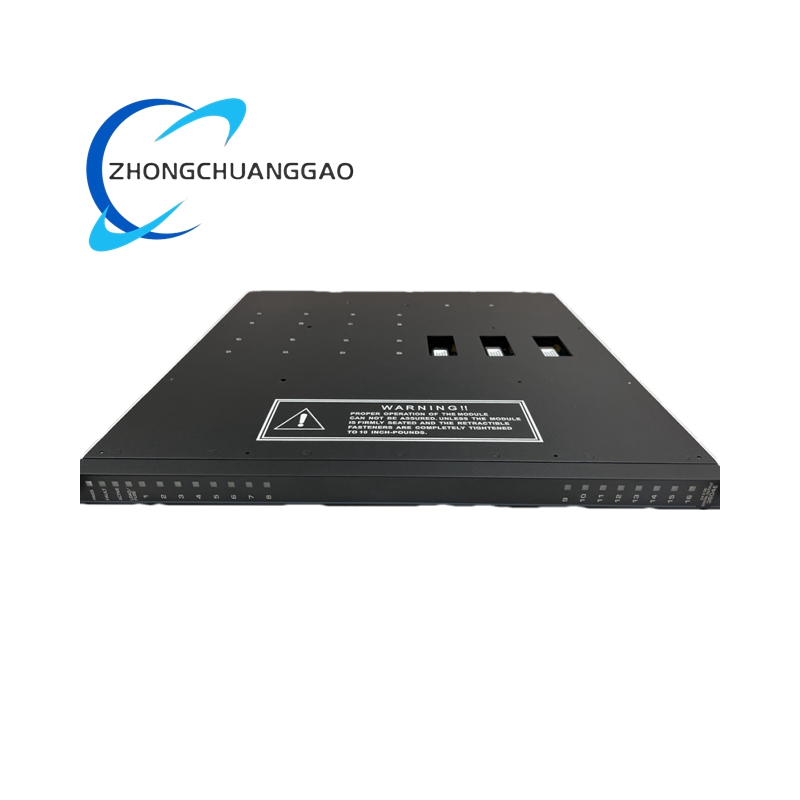
- Architecture: Triple Modular Redundant (TMR) with High Integrity Fault Tolerance (HIFT) design.
- Channels: Three independent processing channels for fault tolerance.
- Data Transmission Rate: 250 Mbps between modules and expansion interfaces.
- Voltage Specifications:
- Internal voltage supplied via module connector from expansion chassis backplane.
- Field voltage range: Up to 60 Vdc (with specific connection restrictions above 32 Vdc).
- Power Dissipation: 0.5 W per power group.
- Isolation:
- 50 Vrms reinforced isolation between power groups.
- 250 Vrms basic isolation for fault conditions.
- Operating Temperature: 0 °C to +60 °C (32 °F to +140 °F).
- Storage Temperature: -25 °C to +70 °C (-13 °F to +158 °F).
- Relative Humidity: 10% to 95%, non-condensing.
- Dimensions: Height 110 mm (4.33 in), Width 360 mm (14.17 in), Depth 68 mm (2.67 in).
- Weight: 950 g (2.1 lb).
Description
Functional Features
- Fault Tolerance: TMR architecture ensures system continuity by running three independent channels in parallel. If one channel fails, the other two maintain operation without interruption.
- Rapid Fault Detection: Diagnostic and monitoring capabilities provide quick identification of faults, enabling prompt maintenance and reducing downtime.
- Hot Swapping: Supports online replacement without system shutdown, minimizing operational disruptions during maintenance.
- Flexible Configuration: Can be configured as a primary interface for digital or analog output modules, supporting up to 40 channels per field termination assembly (FTA).
- Status Indicators:
- Three LEDs (one per channel) indicate health status (steady green for healthy, blinking red for faults).
- Three Tx/Rx LEDs (one per channel) show communication activity (green for receive, red for transmit, amber for both).
- SmartSlot Connection: Enables “one-to-many” hot replacement of output modules for simplified maintenance.
Application Scenarios
- Power Generation: Manages turbine control, generator monitoring, and distribution network stability in power plants.
- Oil and Gas Industry: Monitors pipeline pressure, compressor stations, and wellhead control systems to ensure safe and reliable operation.
- Petrochemical Plants: Interfaces with reactor agitators, pump systems, and valve operations in hazardous environments.
- Water Treatment: Facilitates aeration turbine control and chemical dosing in wastewater treatment facilities.
- Marine and Offshore: Enhances dynamic positioning systems and engine room monitoring on offshore platforms and vessels.
- Steel and Cement Plants: Used in combustion control systems and other critical process control applications.
Reviews
There are no reviews yet.