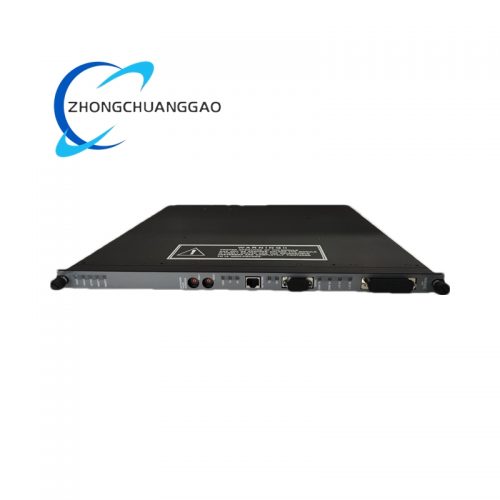
Product Short Description
Technical Specifications
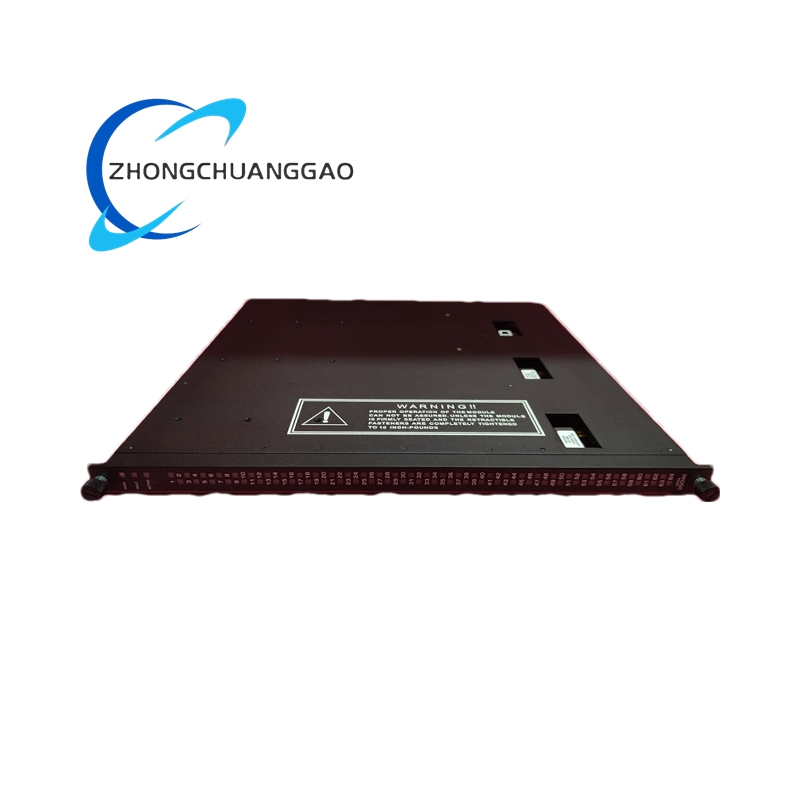
- Input Type: Digital input
- Input Channels: 64 channels (grouped into three independent isolation channels for data processing, but without channel-to-channel isolation)
- Voltage Range: 24 VDC or 48 VDC (configurable in TriStation as 24 or 48 VDC)
- Input Coupling: DC-coupled
- Self-Test Feature: Detects “stuck-on” or “stuck-off” faults in circuits within half a second
- Microprocessor per Channel: Each channel has a dedicated microprocessor to scan input points, compile data, and transmit it to the main processor on demand
- Data Voting Mechanism: Input data is voted on by the main processor before processing to ensure the highest integrity
- Diagnostics: Complete and ongoing diagnostics for each channel; any fault activates a fault indicator and chassis alarm
Description
- Fault Tolerance: Guaranteed to operate properly with a single fault and may continue to operate with certain multiple faults
- Hot Backup Support: Supports hot backup modules, requiring a separate external terminal panel (ETP) with a cable interface to the Tricon backplane
- Mechanical Keying: Prevents improper installation in the chassis
- Operating Temperature: -40°C to +70°C (standard); extended option up to +85°C
- Storage Temperature: -40°C to +80°C
- Humidity: Up to 90% (non-condensing)
- Protection Class: IP30 (IP66 optional)
- Mechanical Design:
- Dimensions: 132 mm × 105 mm × 52 mm
- Weight: 1.36 kg
- Mounting: 35 mm DIN rail
- Housing: Wave-patterned aluminum alloy for enhanced durability
- Certifications: IEC 61508 SIL 3, TÜV SIL 3, EN 55022, EN 61000-4-2/3
Functional Features
- Triple Modular Redundancy (TMR): Each input signal is processed by three independent channels, ensuring fault tolerance through a 2-out-of-3 voting mechanism. This eliminates single points of failure and guarantees continuous operation even if one or two channels fail.
- High Reliability: Built with industrial-grade components and rigorous manufacturing processes to withstand extreme temperatures, vibrations, and electromagnetic interference (EMI).
- Fast Response Time: Sub-millisecond signal processing ensures timely detection of input changes, critical for safety-critical applications.
- Online Replacement (Hot Swap): Modules can be replaced without powering down the system, minimizing downtime and maintenance costs.
- Comprehensive Diagnostics:
- Self-diagnostics for stuck-open/stuck-closed conditions.
- Detection of wire breakage, short circuits, and channel faults.
- Fault indicators point to channel faults, not module failures, for easier troubleshooting.
- Flexible Input Types: Supports both dry contacts (passive switches) and wet contacts (active sensors requiring external 24 VDC power).
- Signal Conditioning: Each channel independently conditions signals between the field and the Tricon controller, ensuring signal integrity.
- Self-Test Circuit: Detects all “stuck-on” and “stuck-off” fault conditions within half a second, enhancing system safety.
Application Scenarios
- Oil and Gas Industry: Emergency shutdown systems (ESD), fire and gas detection (F&G), and wellhead pressure monitoring.
- Petrochemical Plants: Safety instrumented systems (SIS) for monitoring reactors, distillation columns, and storage tanks.
- Nuclear Power: Reactor protection systems and turbine control to ensure safe operation under abnormal conditions.
- Mining and Metallurgy: Conveyor control, ventilation systems, and gas detection in underground mines.
- Power Generation: Boiler protection, generator control, and auxiliary system monitoring in thermal power plants.
- Marine and Offshore Platforms: Drilling rig control and safety systems for offshore oil and gas production.
Advantages
- Unmatched Reliability: TMR architecture ensures continuous operation even under fault conditions, providing the highest system availability.
- High-Density Design: 64 input channels in a single module reduce space requirements and simplify wiring.
- Cost Efficiency: Reduces long-term maintenance costs through modular design, online diagnostics, and hot-swappable capabilities.
- Versatility: Integrates seamlessly with various industrial equipment and systems via multiple communication protocols (e.g., Modbus, Profibus, Ethernet).
- Robustness: Withstands extreme temperatures, humidity, and vibrations, ensuring reliable performance in harsh industrial environments.
- Scalability: Easily expands to accommodate increasing control demands without system overhaul, making it suitable for evolving industrial needs.
Reviews
There are no reviews yet.