
Product Short Description
Technical Specifications
- Input & Communication Parameters
- It has 8 independently isolated input channels, compatible with HART specification versions 5, 6, and 7, and supports mixed connection of 4 – 20mA analog devices and HART intelligent devices.
- The analog conversion accuracy reaches ±0.075% of full scale, with a 15-bit resolution and an update rate of 100 milliseconds, ensuring high-precision and real-time data collection.
- It operates at a baud rate of 1200 and can send and receive two digital messages per second with each HART field device, enabling bidirectional stable communication.
- The maximum length of termination cables can reach 30 meters, meeting flexible wiring needs of different industrial sites.
- Electrical Specifications
- The power supply is 24V DC, with a voltage tolerance of +5% and -10%, a maximum power consumption of 7W, and a maximum heat dissipation of 4W.
- The minimum loop supply voltage is 18.5V DC at 20.5mA, with a single-channel current limit of 37mA and a redundant-mode current limit of 72mA.
- The sense resistor has an accuracy of 280Ω ±0.02%, and the input resistance is 282Ω for external use and 302Ω for internal use.
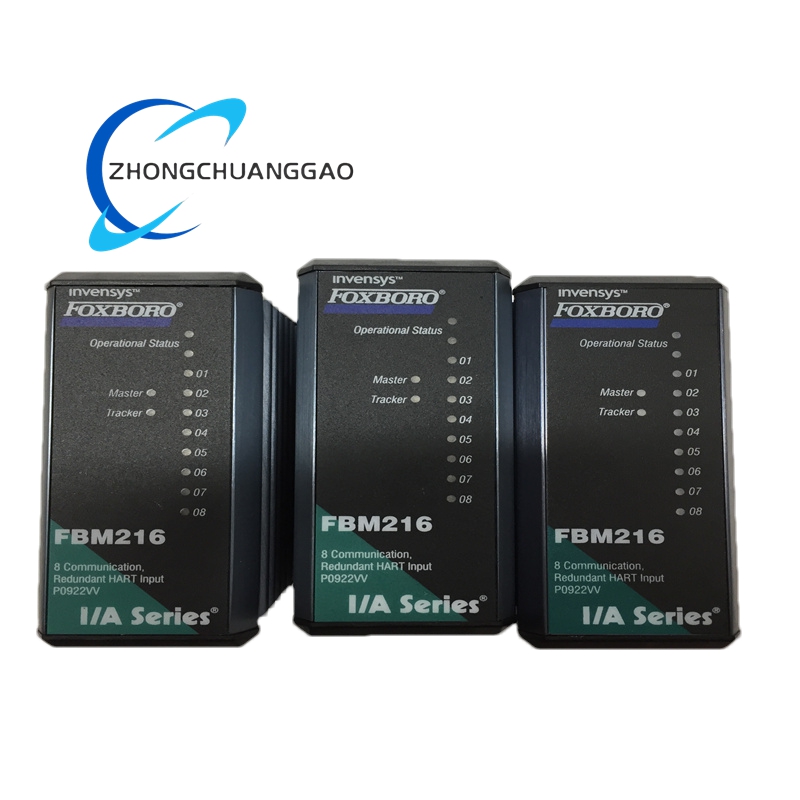
Description
- Physical & Environmental Specifications
- The module dimensions are 102mm × 45mm × 104mm, weighing about 284g, and the matching termination assembly weighs 181g.
- It supports 32mm or 35mm DIN rail mounting and 19-inch rack mounting with a mounting kit.
- The operating temperature ranges from -20°C to +70°C, and the storage temperature ranges from -40°C to +70°C, adapting to 5% – 95% non-condensing humidity and an operating altitude of -300 meters to 3000 meters.
- It has 600V AC isolation between channels and the ground for 1 minute, with common mode rejection >100dB and normal mode rejection >35dB at 50/60Hz.
Function Features
- Dual Redundancy Design Ensures System Stability
The module achieves redundancy at the FBM level when two units are used in combination. One module serves as the master and the other as a tracker, with field input signals connected to a shared terminal assembly. This redundancy mechanism avoids data collection interruptions caused by single-module failures, which is critical for industrial processes that require uninterrupted operation.
- Independent Isolation and High Anti-Interference Capability
Each of the 8 input channels is galvanically isolated from each other, the ground, and the module logic. This design completely eliminates signal crosstalk between channels and prevents damage to the module from voltage surges or electromagnetic interference in complex industrial environments. The high common mode and normal mode rejection further enhance the purity and stability of input signals.
- High-Precision Conversion and Versatile HART Command Support
It adopts sigma-delta conversion technology for each channel, which achieves high-precision analog-to-digital conversion of 4 – 20mA signals. It supports HART universal commands, common practice commands, and device-specific commands, allowing the DCS to not only collect analog process data but also retrieve diagnostic information such as device fault status and operating parameters, and send configuration commands to field devices.
- Flexible Installation and Strong Environmental Adaptability
It supports multiple mounting methods including DIN rail and 19-inch rack mounting, and is equipped with terminal assemblies for local or remote connection of field wiring. Its rugged structure can withstand harsh conditions such as dust, vibration, and extreme temperatures, and it can maintain stable performance in G3-class harsh industrial environments that meet ISA standard S71.04.
Application Scenarios
- Petrochemical Industry
It is widely used in oil refineries, chemical synthesis plants and oil and gas transmission stations. It connects with HART pressure transmitters on reactors, flow meters on pipelines and temperature sensors in distillation towers. It collects real-time data such as reaction pressure, medium flow rate and distillation temperature, and the redundant design ensures that data collection will not be interrupted due to module failures, avoiding safety accidents such as material leakage and over-temperature reactions.
- Power Industry
It is deployed in coal-fired, gas-fired and nuclear power plants, matching with HART sensors on boiler combustion systems, steam turbines and water supply systems. It monitors key parameters such as boiler temperature, steam pressure and circulating water level in real time. The high-precision data collection helps the central control system adjust fuel supply and steam output in a timely manner, ensuring stable power generation and preventing equipment damage caused by parameter deviations.
- Water Treatment Industry
It is installed in urban sewage treatment plants and industrial wastewater treatment workshops, connected with HART water quality sensors, liquid level transmitters and flow meters. It collects data such as pollutant concentration, sedimentation tank liquid level and water treatment flow rate. The DCS adjusts the operation of dosing pumps and water pumps according to the data, ensuring that the treated water meets discharge standards, and the redundancy function ensures the continuity of the water treatment process.
- Pharmaceutical Industry
It is integrated into pharmaceutical production lines for drug synthesis and filling processes. It connects with HART flow meters and pressure sensors in reaction kettles and filling equipment to accurately collect data such as raw material addition volume and filling pressure. Its high accuracy meets the strict requirements of GMP standards for production process parameters, and the HART communication function realizes traceability of process data, improving the qualification rate of pharmaceutical products.
- Metallurgical Industry
It is applied in steelmaking, non-ferrous metal smelting workshops, connected with HART temperature sensors in smelting furnaces and pressure transmitters in pipeline systems. It collects real-time data on smelting temperature and molten metal flow rate, and transmits the data to the DCS. The control system adjusts the input of fuel and additives according to the data, ensuring the stability of metal smelting quality, and the redundant design prevents production interruptions caused by equipment failures.
Reviews
There are no reviews yet.