
Product Short Description
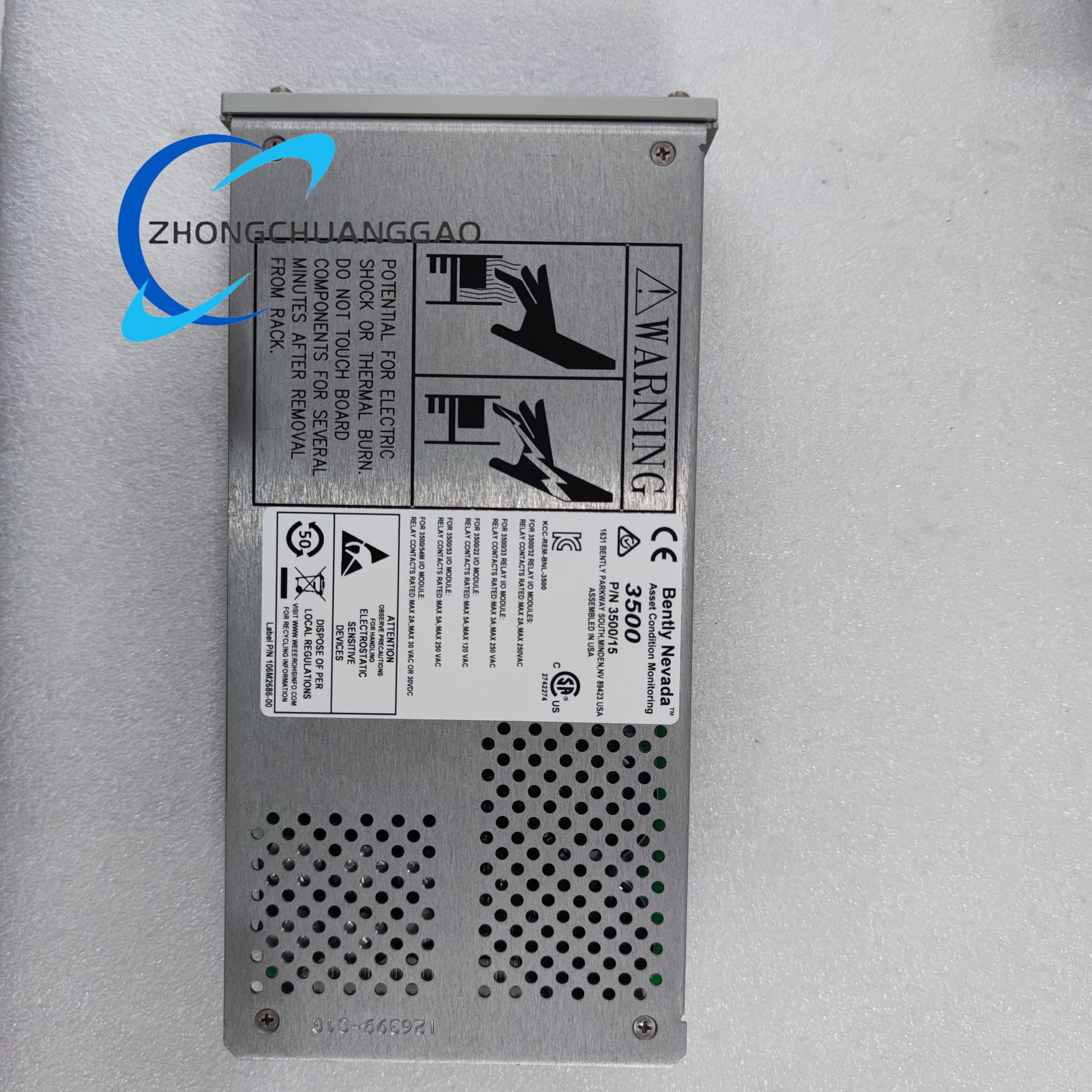
The naming convention of the product carries clear functional indicators: “3500” denotes the foundational 3500 product series, “/15” classifies it as a dedicated communication module within the series, and “127610-01” is the unique part number that identifies its specific hardware configuration (Modbus TCP/IP focus) and production revision. Unlike general-purpose communication modules, this model is engineered to seamlessly bridge the proprietary 3500 backplane bus with Modbus TCP/IP networks, the most widely adopted industrial communication protocol, enabling real-time transmission of critical machinery data (vibration, displacement, temperature, alarm status) to Modbus-compatible DCS, SCADA, and data acquisition systems. It integrates natively with all 3500 series modules, including vibration transmitters (3500/05), I/O modules (3500/42), and display modules (3500/20), eliminating the need for additional adapters or gateways. Constructed to withstand harsh industrial environments, the module features galvanic isolation, robust EMI/RFI shielding, and a compact rack-mount design tailored for 3500 system chassis. By ensuring reliable, protocol-compliant data flow between the 3500 monitoring system and upper-tier control platforms, it empowers industries to implement predictive maintenance, reduce unplanned downtime, and ensure the safe operation of high-value assets such as turbines, compressors, and gearboxes.

Description
Technical Specifications
-
Full Part Number: Bently 3500/15 127610-01
-
Module Category: Modbus TCP/IP communication gateway (3500 system-compatible)
-
Core Communication Protocol: Primary Protocol: Modbus TCP/IP (client/server dual-mode)
-
Protocol Compliance: Modbus Application Protocol Specification V1.1b
-
Supported Modbus Functions: 03 (Read Holding Registers), 06 (Preset Single Register), 16 (Preset Multiple Registers), 23 (Read/Write Multiple Registers)
-
Additional Protocol: Modbus RTU over TCP (optional, via software configuration)
Network Interface: Ports: 2 x 10/100 Base-TX Ethernet ports (RJ45 connectors, auto-MDI/MDI-X)
Network Topology: Star, line, or redundant ring (via external network switches)
IP Configuration: Static IP address or DHCP client; subnet mask, gateway, DNS configurable
Maximum Concurrent Connections: 32 Modbus TCP/IP clients (server mode)
Data Transmission Performance: Data Transfer Rate: Up to 100 Mbps (Ethernet port); 1000 samples/second (from 3500 backplane)
Modbus Response Time: <5 ms (for 100 registers read request)
Maximum Data Frame Size: 1500 bytes (Ethernet MTU compliant)
Register Mapping: 40001–49999 (user-configurable for 3500 data points)
3500 System Integration: Backplane Interface: 3500 system proprietary backplane (100 Mbps, redundant)
Supported 3500 Data Types: Vibration (displacement/velocity/acceleration), temperature, pressure, sensor health, module status, alarm flags
Maximum Monitored Data Points: 256 (distributed across connected 3500 modules)
Configuration Tool: Bently 3500 Configuration Software v6.0+ (Windows-compatible)
Electrical Parameters: Power Supply: 24 V DC ±15% (supplied by 3500 chassis backplane)
Power Consumption: 4 W (typical); 6 W (maximum, with dual Ethernet active)
Galvanic Isolation: 2500 Vrms (Ethernet ports to backplane; power to signal)
Input/Output Impedance: 100 Ω ±20% (Ethernet ports, balanced)
Environmental Resistance: Operating Temperature: -40 °C to +75 °C (-40 °F to +167 °F)
Storage Temperature: -55 °C to +85 °C (-67 °F to +185 °F)
Relative Humidity: 5%–95% RH (non-condensing), 40 °C maximum dew point
Altitude: Up to 3,000 meters (9,843 feet) without performance degradation
Mechanical & Protection Specifications: Housing: Anodized aluminum, IP40 rating (when installed in 3500 chassis)
Mounting: 3500 system 19-inch rack chassis, 1 slot occupancy
Dimensions: 15.2 mm (W) x 152.4 mm (H) x 228.6 mm (D)
Weight: 0.5 kg (1.1 lbs)
Shock Resistance: IEC 60068-2-27, 50 g peak (11 ms half-sine pulse)
Vibration Resistance: IEC 60068-2-6, 10 g rms (10–2000 Hz, all axes)
EMC & Safety Certifications: EMI/RFI Immunity: EN 61326-1 (Industrial Class A)
ESD Protection: IEC 61000-4-2, ±8 kV (contact), ±15 kV (air)
Surge Protection: IEC 61000-4-5, ±2 kV (line-line), ±4 kV (line-ground)
Safety Certifications: UL 61010-1, CSA C22.2 No. 61010-1, CE Marking, ATEX/IECEx (Zone 2/22, optional)
Function Features
-
Dual-Mode Modbus TCP/IP Operation: Supports both Modbus TCP/IP server and client modes, enabling flexible integration with diverse industrial control systems. As a server, it allows DCS/SCADA systems to query 3500 asset data; as a client, it can actively push critical alarm data to predefined Modbus masters, ensuring rapid response to equipment anomalies.
-
Redundant Ethernet Connectivity: Dual 10/100 Mbps Ethernet ports support network redundancy, either via spanning tree protocol (STP) or industrial ring networks. In the event of a primary network failure, the module automatically switches to the secondary port within 100 ms, eliminating data transmission interruptions and ensuring continuous asset monitoring.
-
Native 3500 Backplane Integration: Directly interfaces with the 3500 system’s proprietary backplane, enabling plug-and-play integration with all 3500-series modules. No external adapters or converters are required, simplifying system architecture and reducing potential points of failure.
-
Customizable Register Mapping: Offers user-configurable Modbus register mapping (40001–49999 range) for 3500 data points, allowing alignment with existing SCADA/DCS tag databases. This feature eliminates the need for custom software development, accelerating system deployment and integration.
-
High-Speed Data Acquisition: Pulls data from the 3500 backplane at a rate of 1000 samples per second, ensuring capture of high-frequency vibration transients—critical for detecting early-stage bearing wear, rotor imbalance, or gear tooth damage in rotating machinery.
-
Advanced Fault Diagnostics: Embedded self-diagnostic logic monitors Ethernet link status, backplane communication, power supply stability, and protocol errors. Faults are indicated via front-panel LEDs and transmitted as dedicated Modbus register values, enabling remote troubleshooting and reducing on-site maintenance time.
-
Robust Industrial Isolation: 2500 Vrms galvanic isolation between Ethernet ports, backplane, and power supply prevents ground loops and electrical interference—common in industrial environments with multiple power sources. This isolation ensures data integrity and protects both the module and connected control systems from voltage surges.
-
Wide Environmental Adaptability: Operates reliably in extreme temperature ranges (-40 °C to +75 °C) and high-humidity conditions (5%–95% RH non-condensing), making it suitable for deployment in harsh environments such as arctic oil fields, desert power plants, and offshore platforms.
-
Seamless Configuration via 3500 Software: Fully configurable using Bently’s intuitive 3500 Configuration Software, which provides a graphical interface for setting Modbus parameters, mapping registers, and defining alarm conditions. Configuration files can be saved and cloned for multi-module deployments, ensuring consistency across the monitoring system.
-
Optional Hazardous Area Compliance: ATEX/IECEx certification (Zone 2/22) is available for use in explosive environments, such as oil refineries, chemical plants, and gas processing facilities, eliminating the need for expensive explosion-proof enclosures.
Application Scenarios
-
Oil & Gas (Centrifugal Compressors): Deployed in offshore oil platforms to connect 3500 vibration monitoring systems (tracking compressor rotor displacement and bearing acceleration) to a Modbus TCP/IP SCADA system. Dual Ethernet ports ensure data transmission even during platform network maintenance, while the module’s ATEX certification allows use in Zone 2 hazardous areas. Critical vibration data is transmitted to onshore control centers, enabling predictive maintenance and avoiding unplanned compressor shutdowns.
-
Power Generation (Steam Turbines): Installed in coal-fired power plants to integrate 3500 turbine monitoring data (shaft vibration, thrust bearing temperature) with the plant’s Siemens S7-400 PLC via Modbus TCP/IP. Custom register mapping aligns 3500 data with the PLC’s existing tag structure, and the module’s high-speed sampling captures transient vibration during turbine startup—supporting root-cause analysis of abnormal wear.
-
Mining (SAG Mills): Used in copper mining operations to connect 3500 modules monitoring SAG mill pinion gear vibration to a Rockwell FactoryTalk SCADA system. The module’s robust shock resistance withstands mill-induced vibrations, and its Modbus client mode actively pushes alarm data to the SCADA system when vibration exceeds thresholds—triggering immediate maintenance to prevent gear failure and costly production downtime.
-
Chemical Processing (Reactor Agitators): Deployed in chemical plants to monitor reactor agitator vibration via 3500 sensors, with the module transmitting data to a Honeywell Experion DCS using Modbus TCP/IP. Galvanic isolation prevents electrical interference from nearby variable-frequency drives, ensuring accurate data transmission. The module’s wide temperature range allows operation in heated reactor rooms, and its diagnostic features alert operators to communication faults before they impact process monitoring.
-
Marine (Ship Propulsion Systems): Installed in large cargo ships to connect 3500 monitoring systems (main engine vibration, propeller shaft displacement) to the ship’s bridge SCADA via Modbus TCP/IP. Dual Ethernet ports provide redundant connectivity across the ship’s network, and the module’s resistance to high humidity and salt spray ensures reliable operation in marine environments. Vibration data is used to optimize engine performance and prevent breakdowns during long voyages.
-
Steel Manufacturing (Hot Rolling Mills): Used in steel mills to transmit 3500 data (rolling mill work roll vibration, motor bearing temperature) to a Modbus-enabled DCS. The module’s EMI immunity resists interference from electric arc furnaces and welding equipment, ensuring accurate data capture. Modbus register mapping is customized to align with the DCS’s production monitoring tags, enabling operators to correlate vibration levels with product quality metrics.
-
Renewable Energy (Wind Turbine Gearboxes): Deployed in onshore wind farms to connect 3500 gearbox vibration monitoring systems to a central SCADA via Modbus TCP/IP. The module’s low-temperature operation (-40 °C) suits cold-climate wind farms, and its ability to operate as a Modbus server allows the SCADA system to poll data from multiple turbines sequentially. This setup enables centralized predictive maintenance scheduling, reducing turbine downtime by 30%.
-
Automotive (Assembly Line Robots): Installed in automotive assembly plants to monitor robot arm joint vibration via 3500 sensors, with the module sending data to a Fanuc PLC using Modbus TCP/IP. Fast response times (<5 ms) ensure the PLC receives vibration alerts in real time, allowing it to pause the robot if bearing wear is detected—preventing defective part assembly and reducing rework costs.
-
Pharmaceutical (Sterile Process Pumps): Used in pharmaceutical manufacturing to monitor sterile process pump vibration via 3500 modules, with the module transmitting data to a Siemens S7-1200 PLC via Modbus TCP/IP. The module’s compact form factor fits in space-constrained cleanrooms, and its ability to be configured remotely via 3500 software eliminates the need for personnel to enter sterile areas—reducing contamination risks.
-
Aerospace (Test Cell Rigs): Deployed in aircraft engine test facilities to connect 3500 vibration sensors (turbine blade vibration, engine mount acceleration) to a data acquisition system via Modbus TCP/IP. High-speed data sampling captures transient vibration during engine test cycles, and time-stamped data (synchronized via Modbus registers) enables correlation with fuel flow and thrust measurements—supporting engine certification and performance validation.
Reviews
There are no reviews yet.