
Product Short Description
Product Name
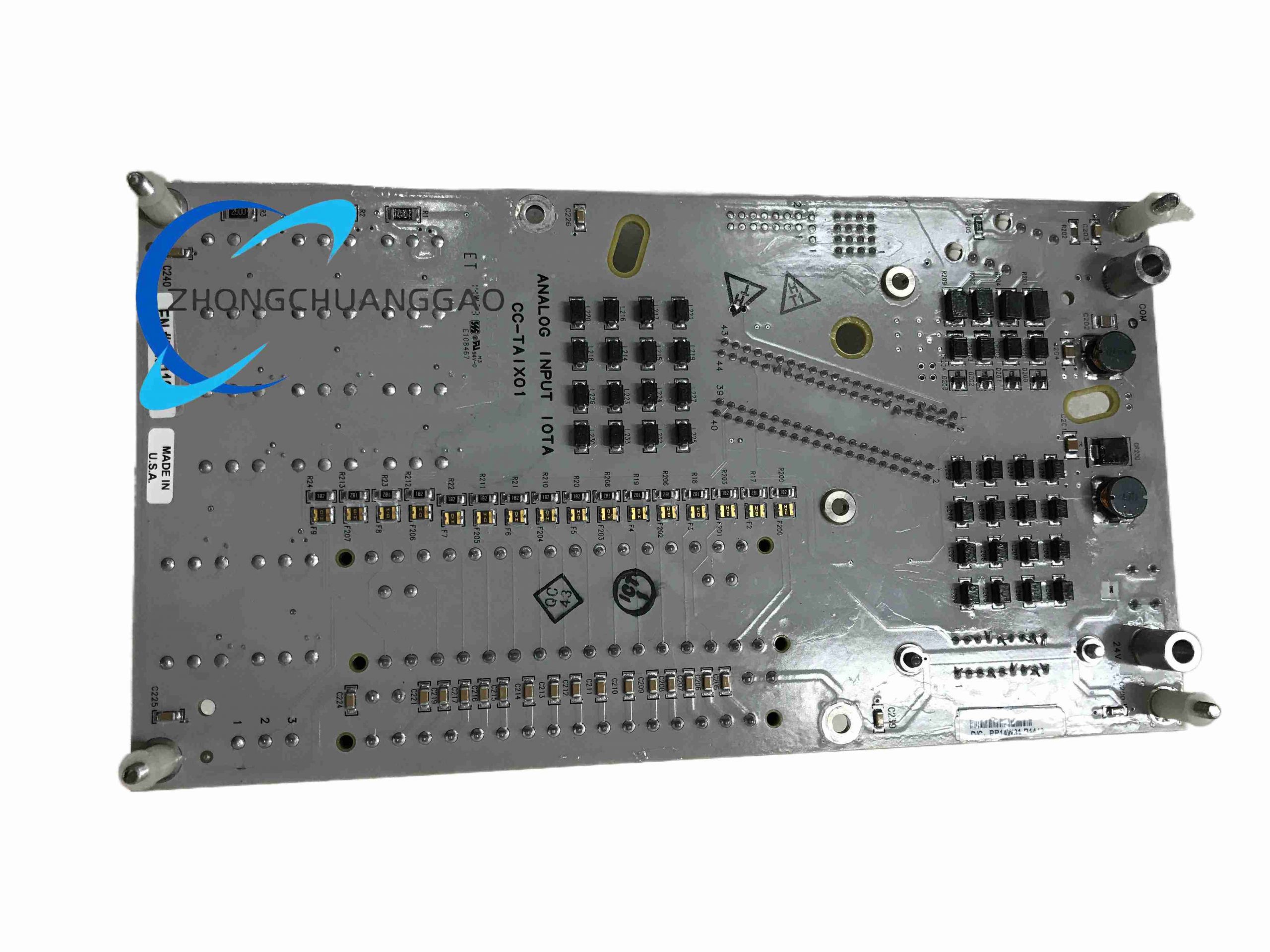
Honeywell CC-TAID11 Analog Input IOTA, Redundant Differential Termination
Product Introduction
CC-TAID11 is a Series C redundant analog input IOTA. It accommodates two high-level analog input modules for bumpless redundancy and provides 16-channel differential or mixed single-ended/differential termination from field transmitters to Experion PKS C300 controllers.
Description
Technical Specifications
Part number: 51306731-175
IOTA type: redundant differential analog input termination assembly
Channels: 16 input terminations, 12 single-ended and 4 differential
Supported inputs: 4-20 mA through 250 Ω, 0-20 mA through 250 Ω, 0-5 V, 1-5 V, 0.4-2 V
Resolution: 16 bits when used with compatible high-level analog input modules
Scan rate: 50 ms
Accuracy: ±0.075% full scale at 23.5°C ±2°C; ±0.15% full scale from 0°C to 60°C
Common-mode rejection: 70 dB dc to 60 Hz with 500 Ω source imbalance
Common-mode voltage range: -6 to +5 V peak dc to 60 Hz
Normal-mode rejection: 19 dB at 60 Hz
Normal-mode filter response: single-pole RC, -3 dB at 6.5 Hz
Maximum differential normal-mode input: ±30 V without damage
Crosstalk: -60 dB dc to 60 Hz, channel to channel
Voltage-input impedance: greater than 10 MΩ when powered
Field power: individually protected current-limiting circuits for Class 1, Division 2 non-incendive interfaces; no external fusing required
Form factor: 12 in-class Series C IOTA for redundant module pair
Operating temperature: 0°C to 60°C; consult the specific board revision for extended ratings
Coating: conformal-coating options for humid and corrosive environments
Functional Features
Supports bumpless redundant analog input operation when paired with two compatible input modules. Provides open-wire detection and Bad-PV diagnostics. Supplies individually protected non-incendive field power. User-configured 250 Ω jumpers select current or voltage operation. Shield and ground provisions simplify noise control in electrically noisy plants.
Application Scenarios
Critical pressure, differential pressure, temperature, flow and level measurements in refineries, petrochemical plants, power generation, offshore production, pharmaceutical manufacturing and large process units. Suitable for redundant transmitter inputs feeding Experion PKS C300 controllers.
Performance Parameters
The IOTA itself performs termination and conditioning; overall input accuracy is determined by the paired analog input module and installed jumpers. Differential channels reject common-mode noise on long cable runs. Four differential channels are available within the 16-channel termination set. Redundant operation maintains process-variable continuity during failure or replacement of one input module.
Material Composition
FR4 termination printed-circuit board, conformal coating option, tinned or plated screw terminals, onboard current-limiting components, metal mounting hardware and insulating barriers between the field and backplane sides.
Structural Characteristics
Vertical 12-inch Series C IOTA with front field terminals and a rear module connector. TB1 and TB2 termination areas support field power, return and signal wiring. The IOTA accepts a primary and secondary analog input module rather than a single module.
Working Principle
Field transmitters connect to the IOTA terminals. Current loops pass through 250 Ω precision resistors to convert current to voltage; voltage inputs connect directly when the associated jumper is cut or removed. The IOTA distributes protected transmitter power and routes conditioned signals to both plugged input modules. The controller receives continuous process data and diagnostics from the active redundant pair.
Installation Requirements
Install CC-TAID11 in the correct redundant Series C carrier position. Insert the designated primary and secondary high-level analog input modules fully until seated. Configure each channel’s 250 Ω jumper for 4-20 mA or 0-20 mA, and remove or cut it for voltage inputs. Connect two-wire transmitters to the loop-power terminals and self-powered transmitters to floating input terminals. Use shielded twisted-pair cable, terminate shields at the defined IOTA ground point, and verify common-mode limits before energizing.
Usage Precautions
Observe carrier and loop power rules before wiring or replacing a module. Do not use CC-TAID11 for simplex applications where CC-TAID01 is specified; the redundant base occupies more cabinet width and requires a matched module pair. Confirm the plugged module supports HART before ordering HART-capable instruments. Incorrect 250 Ω configuration can short voltage sources or distort current-loop readings. Validate both primary and secondary signal paths after commissioning.
Reviews
There are no reviews yet.