
Product Short Description
Product Name
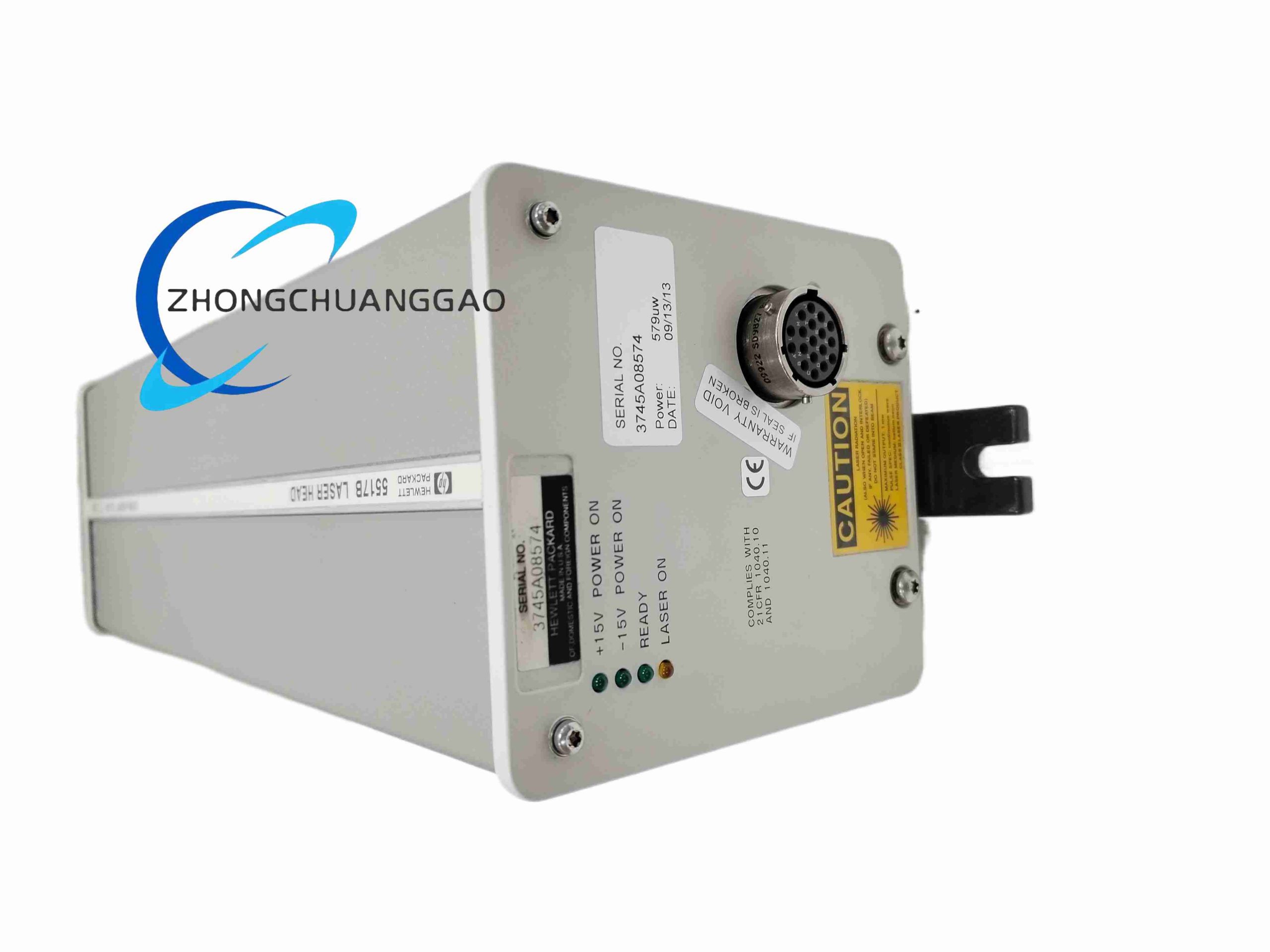
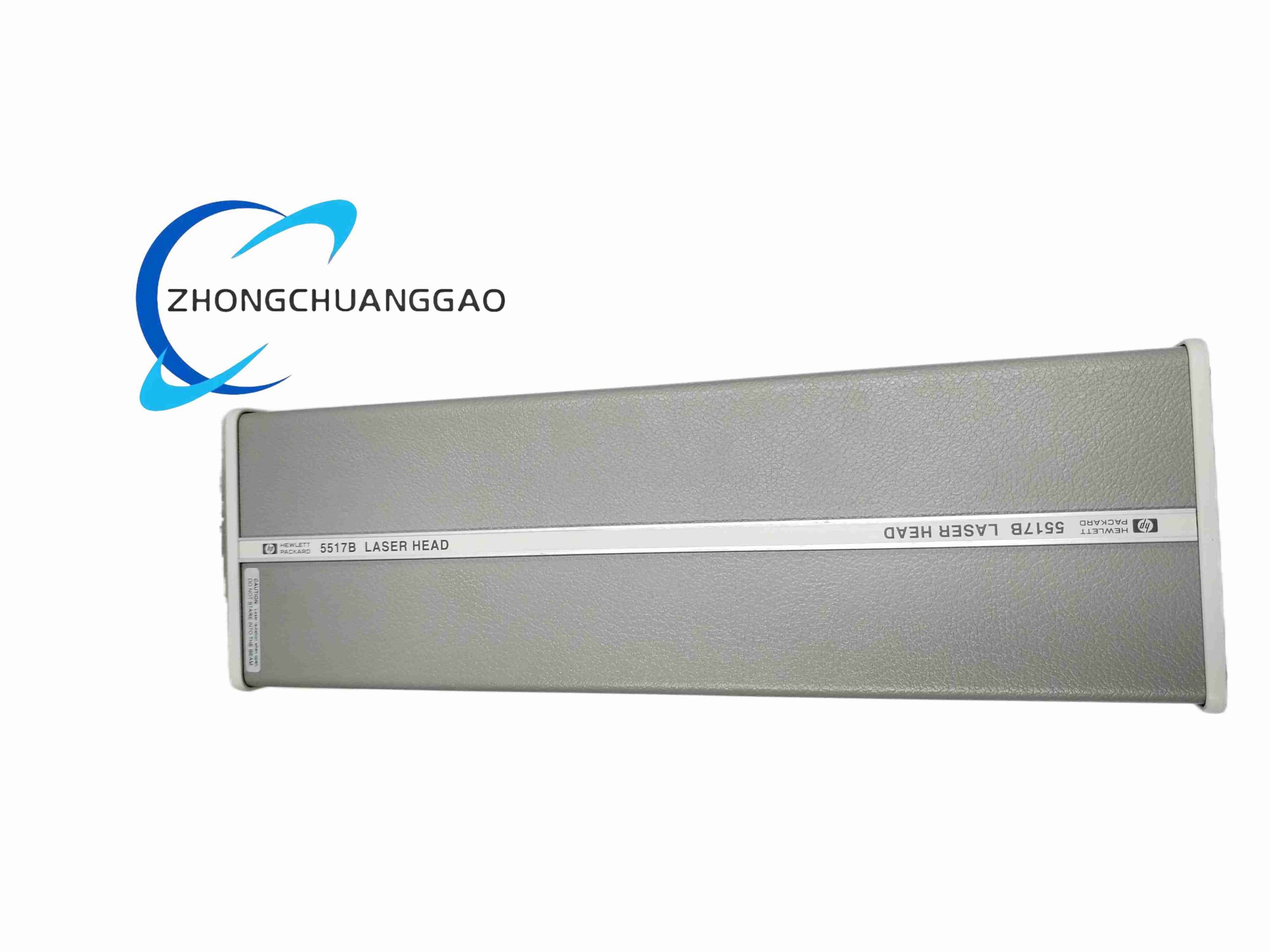
HP 5517B dual-frequency helium-neon laser head for laser interferometer transducer systems.
Product Introduction
The 5517B is a stabilized interferometer laser source used with Agilent/Keysight linear, angular, and straightness optics. It supplies two closely spaced optical frequencies for differential measurement and provides a reference signal for displacement, velocity, and error compensation. The same platform is marketed under Keysight 5517B.
Description
Technical Specifications
Laser type: helium-neon, visible red.
Wavelength: 632.8 nm in air, traceable to vacuum wavelength 632.991 nm.
Reference frequency: 1.9 to 2.4 MHz.
Maximum linear velocity with linear optics: 538 mm/s.
Minimum output power: 120 µW.
Beam diameter: 6 mm standard.
Warm-up time: 90 minutes for full stabilization.
Power supply requirement: external 15 VDC laser power supply, for example Keysight 10884B or approved equivalent.
Beam height: 79.5 mm ±1.0 mm standard configuration.
Functional Features
Zeeman-split dual-frequency output for Doppler interferometry.
Orthogonal polarization separation for reference and measurement beams.
Low drift reference channel for environmental and wavelength compensation.
Compatible with Keysight receiver electronics and VME/PC interferometer systems.
Application Scenarios
CNC machine tool calibration and positioning accuracy verification.
Coordinate measuring machine error mapping.
Semiconductor lithography and wafer-stage metrology.
Optical component testing, flatness, straightness, and angle measurement.
Laboratory length standards and nanometrology.
Performance Parameters
Linear resolution depends on optics and receiver; linear interferometer provides λ/2 counting increment, approximately 316 nm per count at 633 nm.
Velocity capability increases or decreases with optics configuration, receiver model, and direction of travel.
Stabilized output maintains reference frequency within the stated 1.9 to 2.4 MHz band after warm-up.
Materials And Construction
Anodized aluminum/steel laser head body.
Sealed He-Ne plasma tube.
Internal axial magnet assembly for Zeeman splitting.
Output window, beam collimator, and standardized mechanical base.
Working Principle
An axial magnetic field splits the laser emission into two circularly polarized frequencies. A quarter-wave element converts them into orthogonal linear polarizations. One frequency is used as the fixed reference; the other travels through the measurement optic to a moving retroreflector. Mirror motion produces a Doppler frequency shift. The receiver mixes reference and measurement signals and counts the difference to calculate displacement, velocity, or angle.
Installation Requirements
Install the head on a stable, vibration-isolated base aligned with the optical axis.
Connect the approved 15 VDC laser power supply and receiver system.
Allow 90 minutes warm-up before calibration work.
Align beam path using adjustable mounts and verify beam height.
Keep air turbulence, thermal gradients, and reflective scatter under control.
Usage Precautions
Treat the output as Class 2/Class 3R laser radiation according to final system configuration; avoid direct eye exposure.
Never open the laser tube or adjust internal optics without manufacturer authorization.
Maintain recommended ambient temperature and humidity defined by the system manual.
Replace only with same model or Keysight-approved upgrade head to preserve reference frequency and calibration.
Disconnect power before servicing supply wiring.
Reviews
There are no reviews yet.