
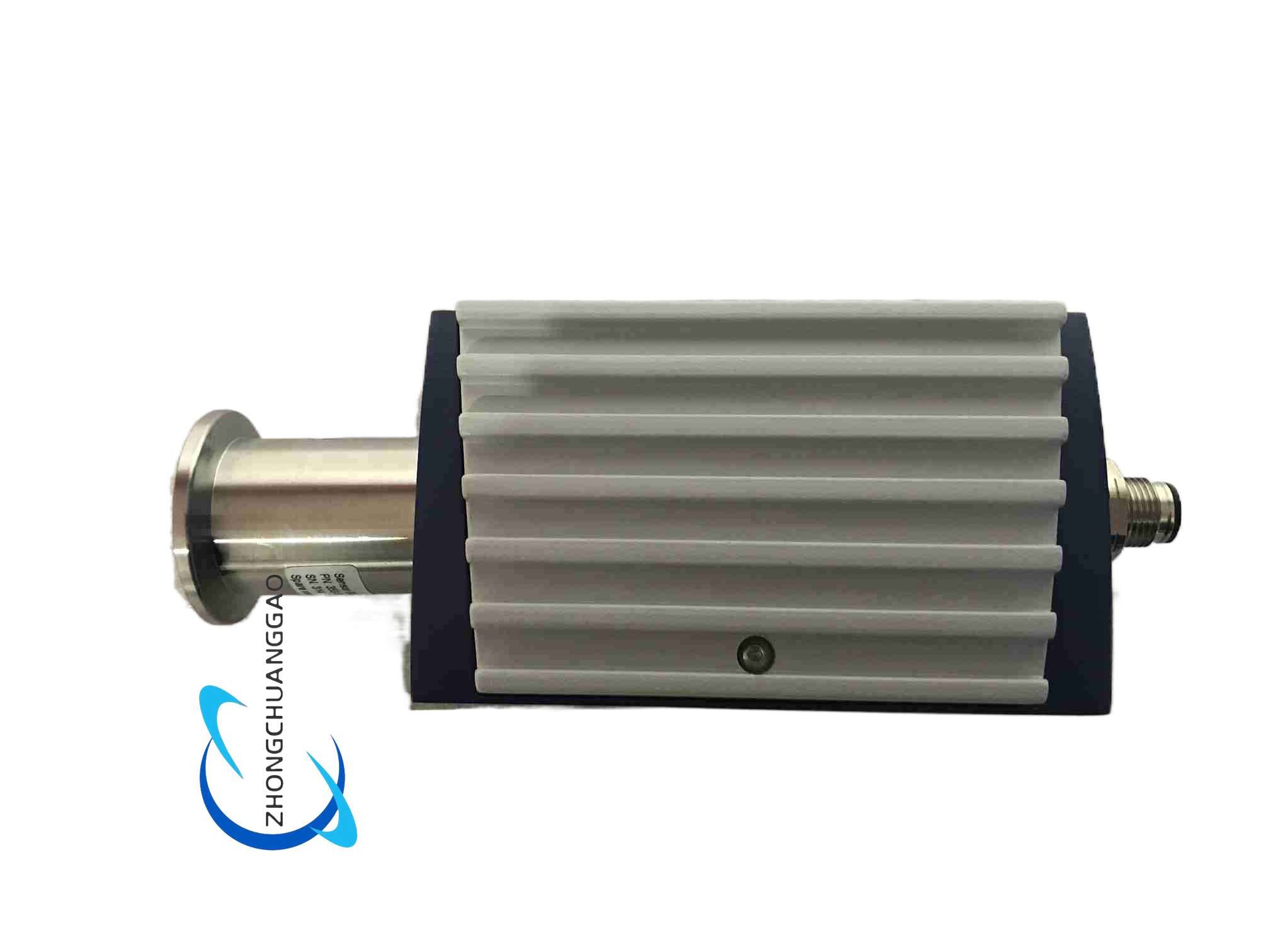
Description
Product Introduction
The BCG450-SD is a vacuum measuring instrument that covers the full range from atmosphere to ultra-high vacuum using three complementary sensor technologies in a single gauge. It is designed for measuring non-flammable gases and gas mixtures and operates in conjunction with INFICON Vacuum Gauge Controllers VGC401, VGC402, or VGC403, or with other control devices.
Technical Specifications
-
Part number: 353-557 (DN 25 ISO-KF flange)
-
Measurement range: 5 × 10⁻¹⁰ … 1500 mbar (3.75 × 10⁻¹⁰ … 1125 Torr)
-
Accuracy:
-
10⁻⁸ … 50 mbar: ±1 % of reading
-
50 … 950 mbar: ±5 % of reading
-
950 … 1050 mbar: ±2.5 % of reading
-
-
Repeatability: ±5 % of reading (10⁻⁸ … 10⁻² mbar)
-
Hot cathode emission: 2 × 10⁻² mbar (high) or 8 × 10⁻³ mbar (low), selectable via RS232/fieldbus
-
Degas: electron bombardment, max. 3 minutes
-
Max absolute pressure: 5 bar
-
Ambient operating temperature: 0 … +50 °C
-
Storage temperature: −20 … +70 °C
-
Bakeout temperature at flange: 80 °C; 150 °C with electronics removed
-
Interface: DeviceNet with integrated switching functions
-
Automatic gauge adjustment; no manual adjustment required
-
User-programmable atmospheric pressure switching function
Function Features
-
Three-in-one sensor design achieves minimized gas-type dependence
-
Capacitance diaphragm sensor provides gas-type-independent measurement from 10 mbar to atmosphere
-
Below 1 mbar, Pirani and hot-cathode ionization sensors take over with only small gas-type dependence
-
Smooth automatic crossover between sensor ranges via built-in electronic circuits
-
Pirani interlock protects the hot filament from premature burn-out
-
Differential pressure measurement at atmosphere eliminates uncertainty caused by atmospheric pressure variations
-
Sensing element is field-replaceable with calibration data stored on-board for high reproducibility
-
Optional baffle available; optional external power supply supported for RS232C operation
Application Scenarios
Semiconductor process chambers, transfer chambers, and load-lock chamber pressure measurement; industrial coating processes; general vacuum measurement and control from low vacuum to ultra-high vacuum; research and analytical instrumentation.
Performance Parameters
Full-range logarithmic pressure signal output; automatic hot-cathode on/off switching at 2.4 × 10⁻² mbar (on) and 3.2 × 10⁻² mbar (off) thresholds; automatic adjustment eliminates operator intervention.
Material & Structure
Stainless-steel vacuum flange (DN 25 ISO-KF), integrated electronics unit that can be removed for high-temperature bakeout, and an optional baffle accessory.
Working Principle
The gauge combines three measurement principles:
-
Capacitance diaphragm sensor — measures absolute pressure mechanically without gas-type dependence above 10 mbar.
-
Pirani sensor — measures thermal conductivity of the gas, taking over below 1 mbar with minimal gas-type dependence and acting as the interlock to protect the hot cathode.
-
Bayard-Alpert hot-cathode ionization sensor — measures pressure in the high/ultra-high vacuum regime by collecting ions produced from gas molecules ionized by the hot filament.
The internal electronics perform continuous, smooth crossover between these three ranges and output a single logarithmic pressure signal across the entire measurement span.
Installation Requirements
-
Mount the gauge to the vacuum vessel using the DN 25 ISO-KF flange with appropriate centering ring and clamp
-
For bakeout above 80 °C, remove the electronics unit first (electronics may be baked to 150 °C separately)
-
Connect the DeviceNet interface cable following INFICON’s BCG450-SD cabling specification
-
If using an optional baffle, install it between the gauge and the process
-
When interfacing with non-INFICON controllers, build the individual sensor cable per the operating manual
-
Set the DeviceNet node address and baud rate as required by the network
Usage Notes
-
Only use for non-flammable gases and gas mixtures as specified
-
Never energize the hot cathode above its pressure threshold; the Pirani interlock handles this automatically but the gauge must be correctly configured
-
Adhere to all applicable safety regulations for the process media
-
Work described in the manual must be carried out only by suitably trained technical personnel
-
Observe the maximum absolute pressure of 5 bar to avoid sensor damage
-
Allow the gauge to warm up and self-adjust before taking precision measurements
-500x500.jpg)
Reviews
There are no reviews yet.