
Product Short Description
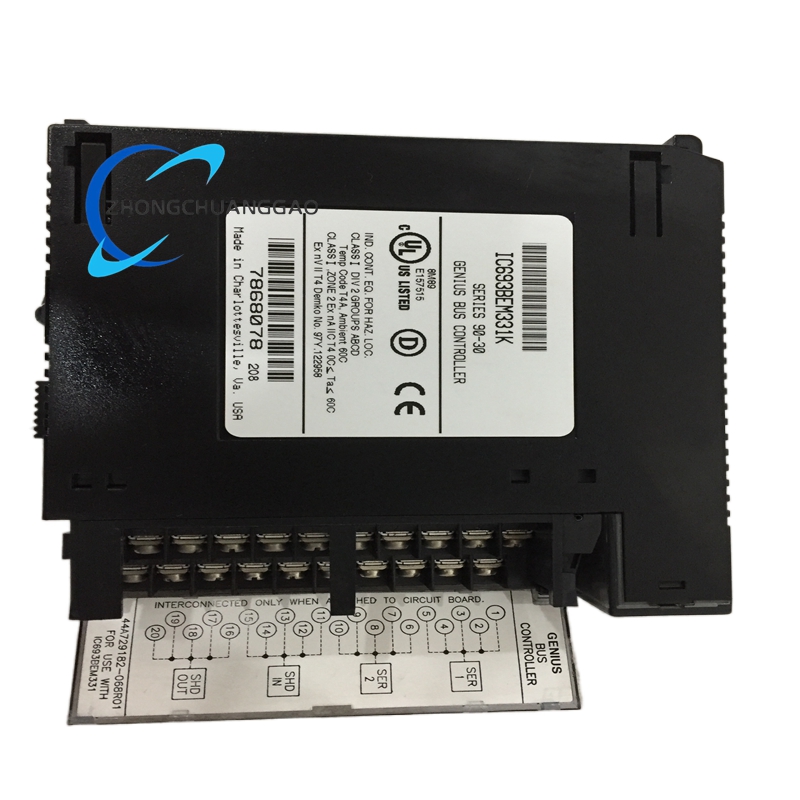
The GE IC693BEM331D is a high‑performance communication module that acts as a Genius Bus Controller (GBC) for the GE Fanuc Series 90‑30 PLC system. It serves as the master interface connecting the 90‑30 PLC CPU to the Genius I/O network, enabling real‑time, deterministic data exchange with up to 31 remote Genius devices. These devices include distributed I/O blocks, variable frequency drives (VFDs), operator interfaces (HMIs), and other PLCs.
Description
Technical Specifications
- Manufacturer: GE Fanuc / Emerson Automation
- Part Number: IC693BEM331D
- Product Type: Genius Bus Controller (GBC) Module
- Compatible System: GE Series 90‑30 PLC (all CPU models), Series 90‑70 PLCs, PACSystems RX3i/RX7i
- Network Protocol: Genius I/O Bus (token‑passing, deterministic)
- Maximum Nodes per Bus: 31 Genius devices (drops)
- Communication Baud Rates:
- 153.6 Kbps (default)
- 76.8 Kbps
- 38.4 Kbps
- Maximum Cable Length:
- 2,500 ft (762 m) at 153.6 Kbps
- 5,000 ft (1,524 m) at 76.8 Kbps
- 7,500 ft (2,286 m) at 38.4 Kbps
- Data Handling Capacity: 128 bytes input / 128 bytes output per device
- Power Consumption:
- +5 VDC (backplane): < 300 mA
- LED Indicators:
- OK: Module power and health status
- COMM OK: Genius bus communication status
- Isolation: 250 VAC (field to logic)
- Operating Temperature: 0°C to +60°C (32°F to 140°F)
- Storage Temperature: ‑40°C to +70°C (‑40°F to 158°F)
- Humidity: 5%–95% RH, non‑condensing
- Shock/Vibration: 5 G (operating), 10 G (storage)
- Mounting: Standard PLC backplane or DIN rail
- Dimensions: 110 mm × 67 mm × 50 mm (4.3” × 2.6” × 2.0”)
- Weight: 0.23 kg (0.51 lbs)
- Certifications: CE, UL, CSA, RoHS (D‑revision compliant)
Key Features
1. Deterministic High‑Speed Communication
- Token‑passing protocol: Ensures fixed, predictable data delivery times for real‑time control, critical for motion and safety applications.
- 153.6 Kbps maximum speed: Delivers fast updates for high‑priority I/O and control data across the Genius network.
- Scalable baud rates: Adjust speed vs. distance to match network layout and performance requirements.
2. Large Network Capacity & Data Throughput
- 31 devices per bus: Supports large distributed I/O architectures, reducing the need for multiple PLCs in expansive facilities.
- 128 bytes I/O per node: Handles complex data exchange, including analog values, machine status, and recipe data.
- Global data sharing: Enables peer‑to‑peer communication between Genius nodes without CPU intervention.
3. Robust Industrial Reliability
- Enhanced electrical protection: “D” revision adds surge suppression and noise filtering for operation in high‑EMI environments (e.g., near motors, welders).
- Wide temperature tolerance: Operates reliably in control rooms and unconditioned field enclosures.
- Conformal coating: Protects PCBs against moisture, dust, and corrosive gases in harsh industrial settings.
4. Comprehensive Diagnostics & Maintenance
- Dual LED indicators: Instant visual status for module health and bus communication, simplifying troubleshooting.
- Network fault detection: Identifies short circuits, open wires, and node failures, triggering PLC alarms for rapid resolution.
- Hot‑swap capability: Replace modules without shutting down the PLC, minimizing downtime during maintenance.
5. Flexible Installation & Compatibility
- Backplane/DIN rail mount: Fits standard 90‑30 racks or standalone DIN rails for versatile cabinet layout.
- Broad compatibility: Works with legacy 90‑30/90‑70 systems and modern PACSystems controllers, protecting existing automation investments.
- Simple configuration: Set baud rate and node addresses via PLC programming software or on‑board DIP switches.
Applications
- Process Industries: Chemical, petrochemical, and pharmaceutical plants for distributed control of reactors, pipelines, and utility systems.
- Manufacturing: Automotive assembly lines, food/beverage processing, and packaging machinery for synchronized motion and I/O control.
- Power Generation: Fossil, hydro, and renewable power facilities for turbine control, boiler monitoring, and balance‑of‑plant automation.
- Oil & Gas: Refineries, pipelines, and offshore platforms for remote monitoring of pumping stations, valves, and safety systems.
- Water & Wastewater: Treatment plants for control of pumps, valves, and instrumentation across geographically distributed facilities.
- Building Infrastructure: Airport, railway, and commercial building automation for HVAC, lighting, and life safety systems.
Reviews
There are no reviews yet.